Cybersecurity compliance got harder in 2025, and 2026 is not going to be kinder. U.S. breach costs hit a record $10.22 million last year while global averages dropped for the first time in five years — a split that tells you everything about where regulators are headed. If you run security for an SMB, an MSSP serving dozens of them, or a vCISO firm advising across a portfolio, the old playbook of annual audits and spreadsheet-based evidence collection is quietly bankrupting you on analyst time.
This guide walks through the 12 frameworks that actually matter, what each one costs to achieve and maintain, how different industries get regulated, and the specific shift from point-in-time audits to continuous compliance monitoring that's reshaping how cyber security compliance services are delivered. It's written for people who have to actually do this work, not just describe it.
What cybersecurity compliance actually means in 2026
Cybersecurity compliance is the practice of proving, with evidence, that your organization meets a defined set of security controls established by a law, regulator, industry body, or customer contract. The key word is proving. You can have perfect security and still fail compliance if you can't produce evidence an auditor accepts. You can also pass an audit with a mediocre security posture if you game the evidence window — which is roughly how the 2013 Target breach happened three months after a clean PCI assessment.
The 2026 version of cybersecurity compliance has three new pressures that the 2022 version did not. Regulators now expect continuous monitoring, not annual snapshots. AI governance requirements are being bolted onto existing frameworks. And supply-chain liability is being pushed down to SMBs through contractual compliance clauses from their enterprise customers. These three forces are what make cyber security compliance fundamentally different from what it was even two years ago.
Why cybersecurity compliance matters (with 2025 breach data)
The business case for cybersecurity compliance used to be "avoid fines." That's still true, but it's now the third most important reason.
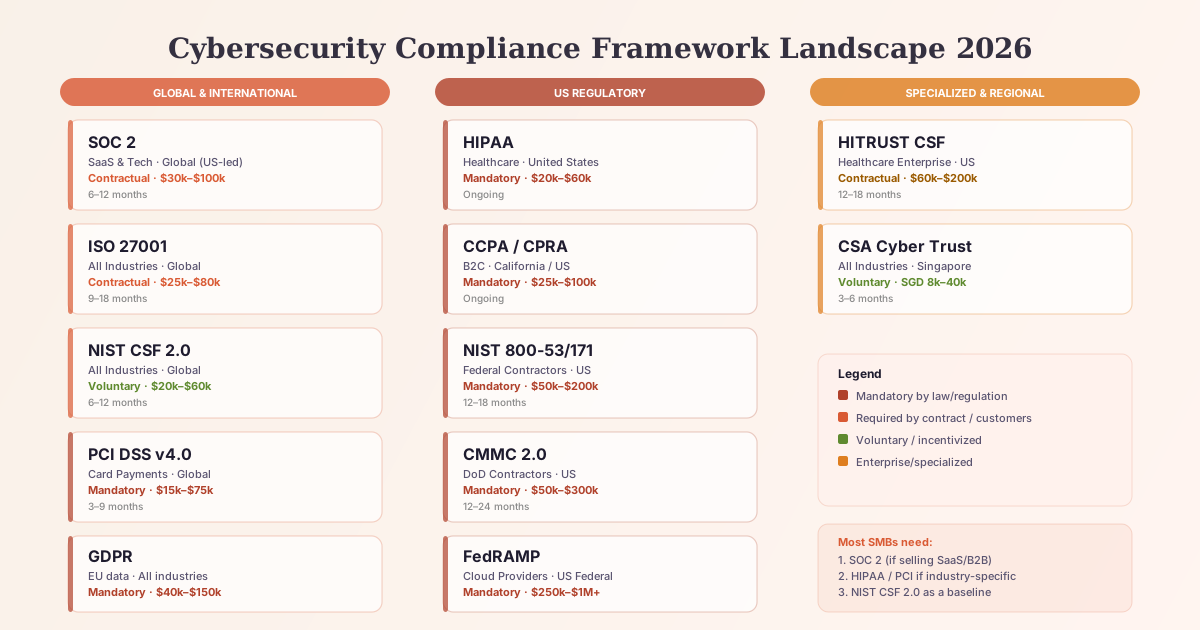
Reason one: the financial delta is widening. IBM's 2025 Cost of a Data Breach Report puts the global average at $4.44 million per breach. In the U.S. the number is $10.22 million, a record. Organizations using AI-driven security automation saved an average of $1.9 million per incident compared to organizations that didn't. Compliance frameworks are the scaffolding that forces those controls into place.
Reason two: enterprise customers are pushing compliance down their supply chain. If you sell into regulated industries, you now need SOC 2 or ISO 27001 just to make it past procurement. A 2025 Gartner study found that 60% of enterprise buyers require third-party attestation before signing contracts with SMB vendors. Without it, you're losing deals before you get a call.
Reason three: regulatory enforcement is accelerating. The EU issued €2.1 billion in GDPR fines in 2024, continuing the trend from 2023. CCPA enforcement actions in California have doubled each of the last three years. HIPAA settlements quietly hit a record in 2024. The days of low-probability enforcement are over.
Reason four: your detection time directly affects breach cost. IBM's 2025 data shows the global average breach lifecycle at 241 days. Healthcare breaches take 279 days to identify and contain. Every day beyond 200 days compounds the cost by five to six figures. Compliance frameworks force you to implement detection and response controls that compress that timeline.
The 12 cybersecurity compliance frameworks you need to know
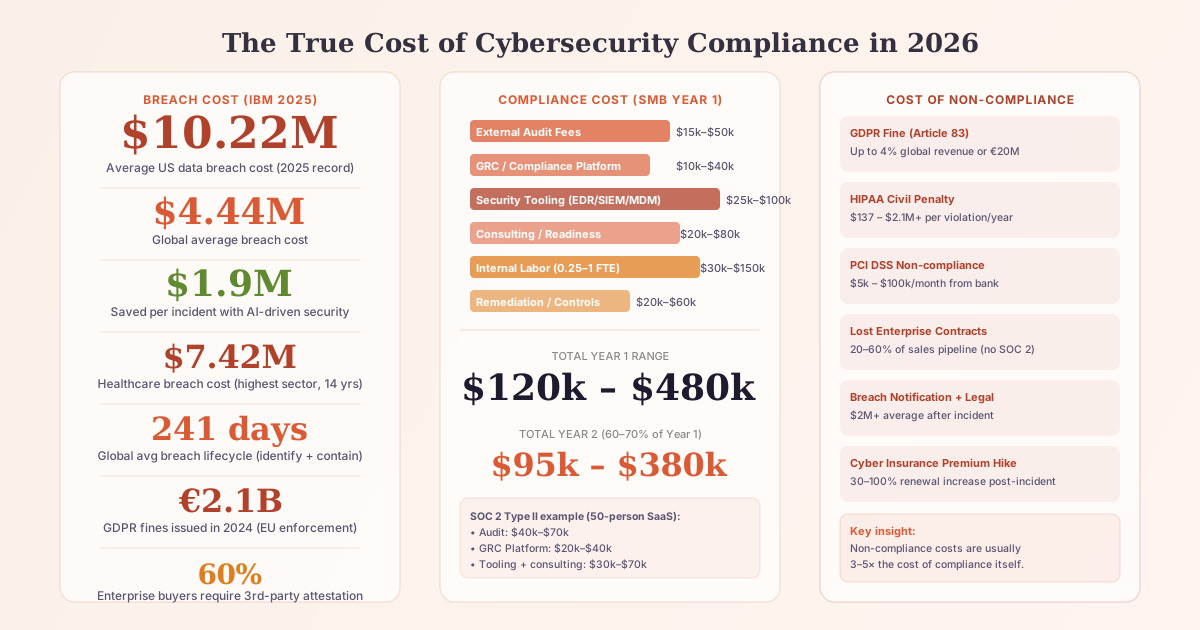
Most articles list four or five frameworks and leave you guessing at the rest. Here's the full landscape you'll actually encounter when running cybersecurity compliance for SMBs and mid-market companies.
Cybersecurity compliance framework comparison
| Framework | Region | Industry | Timeline | Cost (SMB) | Mandatory? |
|---|---|---|---|---|---|
| SOC 2 | Global (US-led) | SaaS, tech | 6–12 months | $30k–$100k | Contractual |
| ISO 27001 | Global | All | 9–18 months | $25k–$80k | Contractual |
| HIPAA | U.S. | Healthcare | Ongoing | $20k–$60k | Mandatory |
| PCI DSS v4.0 | Global | Card payments | 3–9 months | $15k–$75k | Mandatory |
| GDPR | EU / EU data | All | Ongoing | $40k–$150k | Mandatory |
| NIST CSF 2.0 | Global | All | 6–12 months | $20k–$60k | Voluntary |
| NIST 800-53/171 | U.S. gov | Federal contractors | 12–18 months | $50k–$200k | Mandatory |
| CMMC 2.0 | U.S. defense | DoD contractors | 12–24 months | $50k–$300k | Mandatory |
| HITRUST CSF | U.S. | Healthcare, enterprise | 12–18 months | $60k–$200k | Contractual |
| FedRAMP | U.S. federal cloud | Cloud providers | 12–24 months | $250k–$1M+ | Yes for gov't |
| CCPA / CPRA | California | B2C serving CA | Ongoing | $25k–$100k | Mandatory |
| CSA Cyber Trust | Singapore | All | 3–6 months | SGD 8k–40k | Voluntary+ |
SOC 2 is the most common first framework for tech companies. The deliverable is an attestation report (not a certificate) produced by a CPA firm against the AICPA Trust Services Criteria. Type I reports on design of controls at a point in time. Type II reports on operating effectiveness over 6 to 12 months. Most enterprise buyers require Type II.
ISO 27001 is the international equivalent and the preferred framework outside the U.S. It certifies an Information Security Management System (ISMS) and requires an accredited certification body. Renewals every three years with annual surveillance audits.
HIPAA governs Protected Health Information in the U.S. healthcare sector. It has no official certification, only "compliance," which is a trap because enforcement comes after a breach. If you're building for healthcare, read our healthcare cybersecurity and compliance guide.
PCI DSS v4.0 became fully mandatory in March 2025. It applies to any organization that stores, processes, or transmits cardholder data. Version 4.0 introduced customized approach validation, which lets you achieve objectives differently than prescribed if you can prove equivalence.
GDPR applies to any organization processing personal data of EU residents, regardless of where the organization is located. Fines go up to 4% of global annual revenue or €20 million, whichever is higher. It has no certification scheme.
NIST CSF 2.0 is the updated version released in 2024 that added "Govern" as a sixth function alongside Identify, Protect, Detect, Respond, and Recover. It's free, flexible, and the most widely adopted voluntary framework globally. It maps cleanly to ISO 27001 and SOC 2, which makes it useful as a unifying language across programs.
NIST 800-53 and 800-171 are control catalogs for U.S. federal information systems and for federal contractors handling Controlled Unclassified Information (CUI) respectively. 800-171 is what most defense contractors actually implement.
CMMC 2.0 is the Department of Defense's new maturity model that locks 800-171 controls into a three-level certification requirement for anyone in the Defense Industrial Base. Rolling enforcement began in late 2024 and is phasing into DoD contracts through 2028.
HITRUST CSF is a heavyweight unified framework that combines HIPAA, ISO 27001, NIST, PCI DSS, and others. Expensive, but prized in healthcare enterprise sales because a HITRUST certification satisfies almost every other framework simultaneously.
FedRAMP authorizes cloud service providers to serve U.S. federal agencies. It's a significant investment and a long process, but it unlocks a market worth hundreds of billions.
CCPA / CPRA governs consumer privacy in California and has become the de facto U.S. state privacy law template. Fifteen other states now have similar laws, and the patchwork is driving calls for a federal privacy law.
CSA Cyber Trust and Cyber Essentials are Singapore's cybersecurity certifications run by the Cyber Security Agency. Cyber Essentials is the entry-level mark for SMBs, renewable every two years. Cyber Trust is the enterprise-grade version with five tiers. See our detailed breakdown of the CSA Cyber Trust certification in Singapore.
The real cost of compliance for cyber security programs
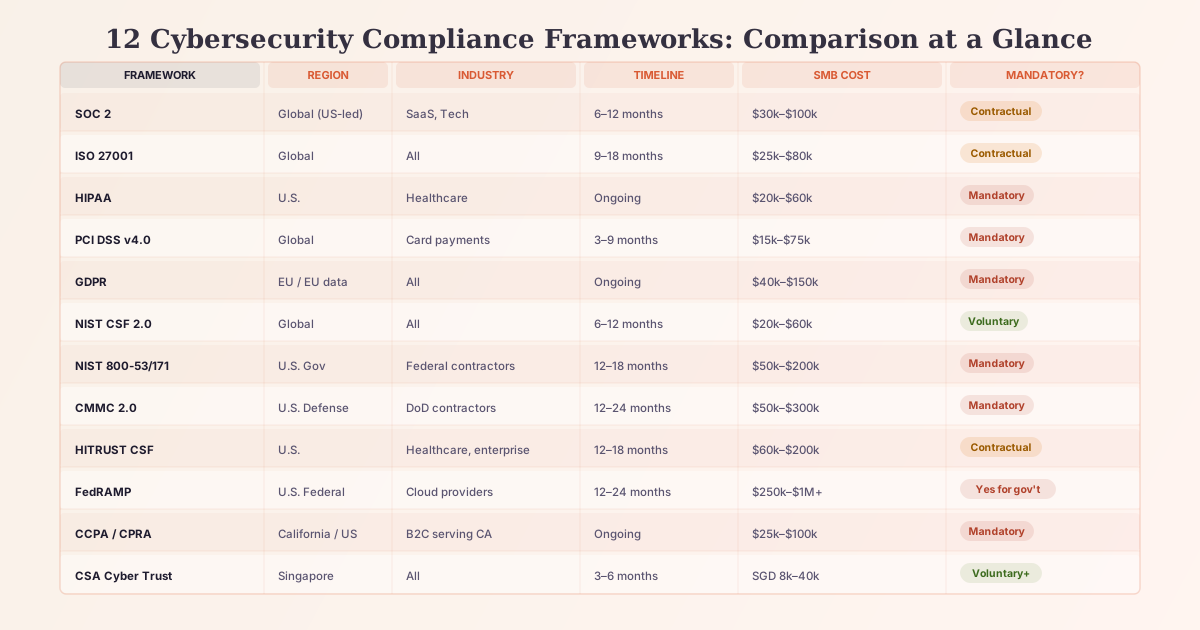
Most budget estimates for cybersecurity compliance miss three of the four actual cost categories. Here's the full picture for a typical SMB or growing mid-market company.
Cybersecurity compliance cost breakdown
| Cost Category | Year 1 Estimate (SMB) | Recurring Annual |
|---|---|---|
| External audit / assessment fees | $15k–$50k | $15k–$50k |
| Compliance platform / GRC tool | $10k–$40k | $10k–$40k |
| Security tooling (EDR, SIEM, MDM) | $25k–$100k | $25k–$100k |
| Consulting / readiness fees | $20k–$80k | $5k–$20k |
| Internal labor (0.25–1 FTE) | $30k–$150k | $30k–$150k |
| Remediation / control implementation | $20k–$60k | $10k–$20k |
| Total | $120k–$480k | $95k–$380k |
A first SOC 2 Type II audit for a 50-person SaaS company in 2026 typically runs $40k–$70k for the audit itself, $15k–$30k for readiness consulting, $20k–$40k for a GRC platform like Vanta, Drata, or Secureframe, and another $15k–$40k in new tooling to fill control gaps. That's $90k–$180k before you count the engineering time pulled off roadmap to write policies, configure MFA, harden infrastructure, and feed evidence to the auditor. Internal time often equals external spend.
The second year is cheaper — usually 60–70% of year one — because most controls persist and only surveillance activity is required. This compound effect is why breaking up with your first compliance program to restart later costs more than maintaining the one you have.
What non-compliance actually costs
Regulatory fines are the visible cost. The invisible costs are usually larger.
| Non-compliance cost type | Typical range |
|---|---|
| GDPR fine (Article 83 tier 2) | Up to 4% global revenue or €20M |
| HIPAA civil penalty per violation | $137 to $2.1M+ per violation category per year |
| PCI DSS non-compliance fine | $5k–$100k/month from acquiring bank |
| SEC cybersecurity disclosure failure | $150k–$50M+ (recent enforcement actions) |
| Lost enterprise contracts (no SOC 2/ISO) | 20–60% of sales pipeline |
| Breach notification, legal, PR after incident | $2M+ average |
| Cyber insurance premium increase post-incident | 30–100% renewal hike |
Industry-specific compliance requirements
Cybersecurity compliance looks different depending on what you do. Here's the practical mapping.
Healthcare & healthtech
HIPAA Security Rule is the baseline. HITRUST CSF is increasingly demanded by hospital systems and payers. FDA has separate premarket cybersecurity requirements for connected medical devices under Section 524B. Healthcare breaches averaged $7.42 million in 2025, highest of any industry 14 years running.
Healthcare compliance solutions →Financial services & fintech
SOC 2 and ISO 27001 are table stakes. Add PCI DSS if you process cards, GLBA for consumer financial information, NYDFS 23 NYCRR 500 for New York-regulated entities, and FFIEC guidance if banking-adjacent. MAS TRM for Singapore. Average breach cost: $5.56 million in 2025.
Fintech compliance services →Manufacturing & industrial
NIST 800-171 and CMMC if you're in the defense supply chain. IEC 62443 for industrial control systems and OT environments. NIS2 Directive in the EU. The industrial sector hit $5.00 million average breach cost in 2025, largely driven by ransomware-induced production downtime.
Manufacturing cybersecurity →Professional services
SOC 2 most commonly. ISO 27001 if serving European clients. State bar cybersecurity rules for law firms (increasingly enforced). AICPA requirements for accounting firms.
Professional services guide →Small businesses
CIS Controls Implementation Group 1 is the practical baseline — 56 controls you can actually do without a dedicated security team. Add NIST CSF 2.0 as a communication framework with customers and insurers. Most SMBs should not chase SOC 2 or ISO unless a customer contract demands it.
Small business approach →The five-stage compliance lifecycle
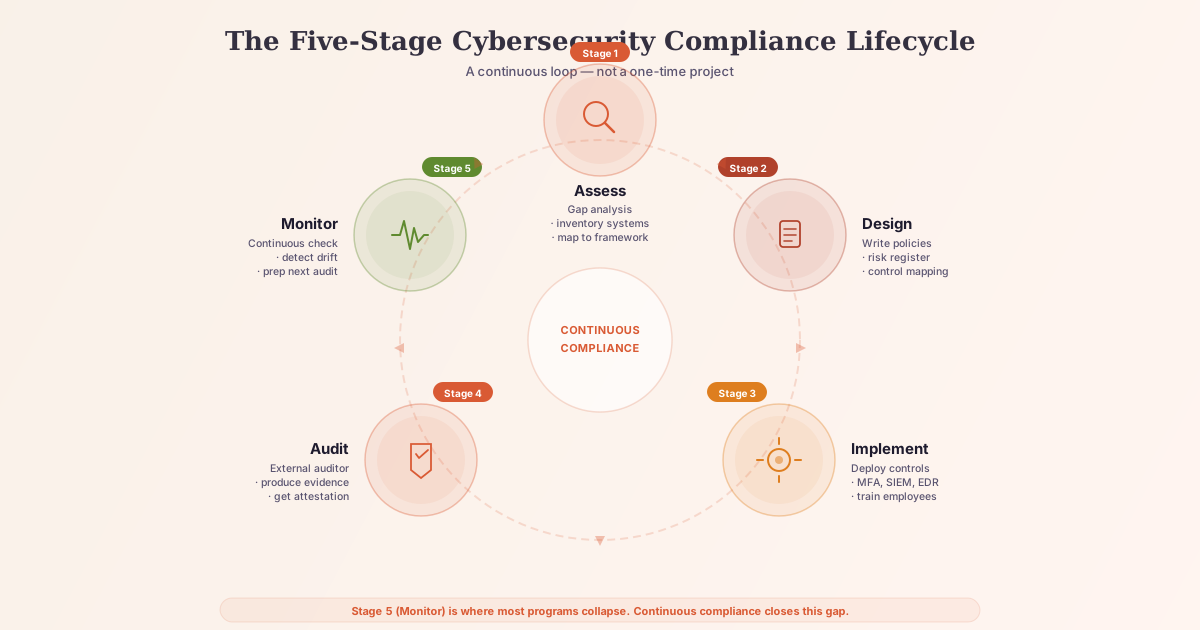
Every cybersecurity compliance program, regardless of framework, moves through five stages. The mistake most SMBs make is treating the lifecycle as a linear project that ends at certification. It's a loop.
Assess
Map your current state against the framework. Run a gap analysis. Inventory data, systems, and third parties. This is where a readiness assessment lives.
Design
Write policies, define procedures, draft the risk register, map controls to framework requirements. Decide what's in scope and what's carved out.
Implement
Configure technical controls (MFA, logging, encryption, access reviews, vulnerability scanning). Train employees. Operationalize processes. This is where most of the cost lives.
Audit
Engage an external auditor or assessor. Produce evidence. Remediate findings. Receive the report, certificate, or attestation.
Monitor ← where programs fail
Continuously verify controls remain in place. Track deviations. Prepare evidence for the next audit window. Update the program as the environment and framework evolve. This is the stage where traditional programs collapse — and where continuous compliance monitoring solves the problem. See our deep dive on continuous compliance monitoring for the tools, 90-day roadmap, and GDPR/HIPAA implementation playbooks.
Building a compliance program in 90 days
If you're starting from zero and need to show material progress by quarter-end, this is the sequence that works.
Assess and scope
Pick the framework (usually SOC 2 Type I or NIST CSF 2.0 tier 2). Run a gap assessment. Inventory systems, data, and vendors. Identify the 10 biggest control gaps.
Design and start implementation
Write the core policy set (information security, access control, incident response, business continuity, vendor management, acceptable use). Deploy MFA everywhere. Turn on centralized logging. Start vulnerability scanning. Enroll a GRC platform.
Implement and audit prep
Close control gaps. Run tabletop incident response exercise. Conduct first access review. Generate evidence. Schedule the Type I audit. Begin the Type II observation window.
Cyber security compliance services: in-house vs. MSSP vs. vCISO
Three delivery models dominate in 2026, and picking wrong wastes six-figure budgets.
In-house
You hire a compliance lead and build the program yourself. Works for companies with more than 200 employees or highly specialized compliance needs. Doesn't work for most SMBs because the fixed cost is too high for part-time need.
MSSP
A managed security service provider runs the full lifecycle for you. Good MSSPs bundle tooling, monitoring, audit prep, and evidence collection. Bad MSSPs sell an expensive dashboard and disappear. Check references, specifically ask about audit support experience.
vCISO
A fractional Chief Information Security Officer provides strategic oversight, 10–40 hours per month. Most effective when paired with either in-house or MSSP operational capacity. A vCISO alone won't implement controls — they'll tell you what needs implementing.
For most SMBs and mid-market companies, the MSSP + vCISO hybrid model delivers the best price-to-outcome ratio. The MSSP runs day-to-day operations, the vCISO owns strategy, board reporting, and audit defense. This is the model we built SecurityPulse AI to support directly.
How to choose a cybersecurity compliance provider
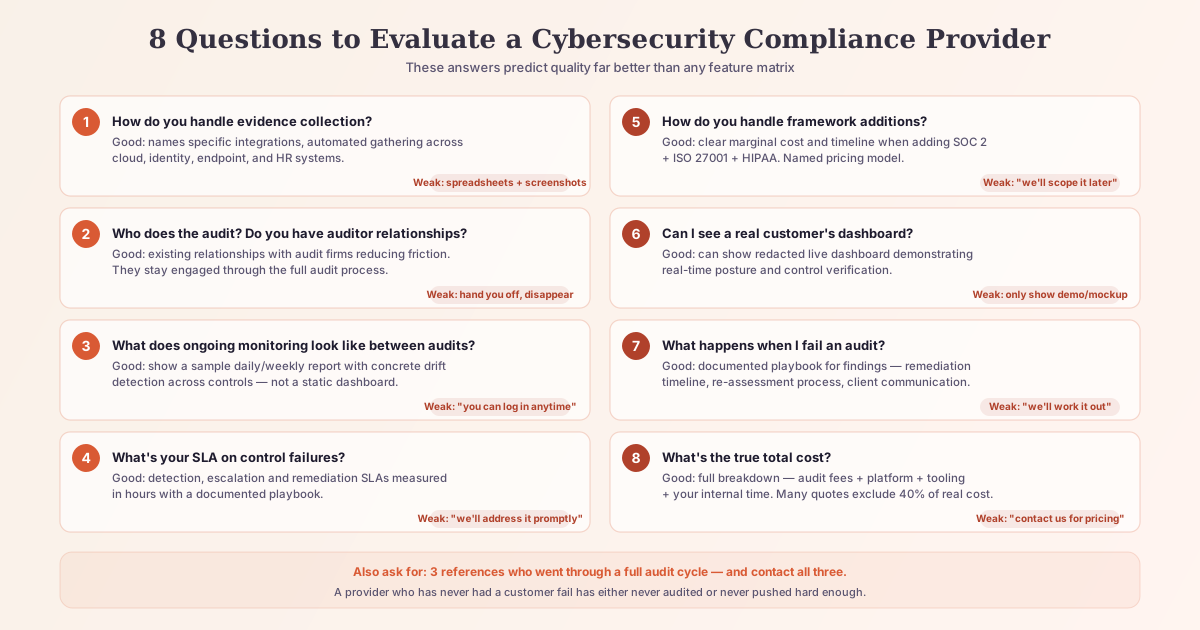
When you evaluate cyber security compliance services, most vendor comparisons focus on features. The features are usually similar. These are the questions that actually separate good providers from expensive ones.
- How do you handle evidence collection? A good answer names specific integrations and describes automated evidence gathering across cloud, identity, endpoint, and HR systems. A weak answer involves spreadsheets and screenshots.
- Who does the audit? Do you have auditor relationships? Strong providers have existing relationships with audit firms that reduce friction. Weak providers hand you off and disappear during the audit.
- What does ongoing monitoring look like between audits? Ask for a sample daily or weekly compliance report. The answer should show concrete drift detection across controls, not a static dashboard.
- What's your SLA on control failures? How fast do they detect, escalate, and remediate? Answers should be in hours, not weeks.
- How do you handle framework additions? When you grow from SOC 2 to SOC 2 + ISO 27001 + HIPAA, what's the marginal cost and timeline?
- Can I see a real customer's dashboard? Redacted if needed. Many providers can't show this because they don't have real ongoing visibility.
- What happens when I fail an audit? Look for specific playbooks, not "we'll work it out." A provider who's never had a customer fail has either never audited or never pushed hard enough.
- What's the true total cost? Audit fees plus platform plus tooling plus your internal time. Many quotes exclude 40% of real cost.
Continuous compliance monitoring: why point-in-time audits are obsolete
A SOC 2 Type II audit observes control operation over 6–12 months. An ISO 27001 certification lasts three years with annual surveillance. HIPAA has no audit cadence; enforcement is reactive. In all three cases, the gap between audit activity and actual environment changes is enormous — and attackers know it.
Continuous compliance monitoring closes that gap by automating evidence collection, control verification, and deviation alerting against framework requirements on a daily or hourly basis. Modern platforms ingest signals from cloud providers, identity platforms, endpoint agents, code repositories, ticketing systems, and HR platforms to maintain a live view of compliance posture. For a deep dive on architecture, tools, and implementation, see our Complete 2026 Continuous Compliance Monitoring Guide.
For MSSPs delivering cyber security compliance services at scale, continuous monitoring is the difference between profitable and unprofitable accounts. Manually running 30 SMB compliance programs is not possible. Automation via continuous monitoring is what turns the service into a business model.
How AI is changing cybersecurity compliance
Three shifts happened in 2025 that reshaped the compliance conversation.
AI is generating new compliance requirements
The EU AI Act, NIST AI RMF, ISO 42001, and emerging state laws create a parallel AI governance compliance track that often sits alongside cybersecurity compliance. Expect this to merge into unified frameworks over the next two years.
AI is being used to exploit compliance gaps
IBM's 2025 data shows 1 in 6 breaches involved attackers using AI, primarily for phishing and deepfakes. Shadow AI (unsanctioned tools used by employees) added $670,000 to breach costs on average. Compliance frameworks are updating to require AI access controls, model inventory, and data leakage prevention.
AI is being used to automate compliance itself
Autonomous agents now handle evidence collection, control verification, alert triage, risk scoring, and audit preparation tasks that used to consume analyst hours. At SecurityPulse AI we call this category Autonomous Extended Security Operations, or AXSO. It's what lets a five-person MSSP deliver cybersecurity compliance for a hundred SMBs without burning out.
Common cybersecurity compliance mistakes
Seven patterns we see repeatedly across SMB and mid-market compliance programs.
The bottom line on cybersecurity compliance in 2026
Cybersecurity compliance stopped being a project and became an operating function somewhere between the 2023 SEC cybersecurity disclosure rule and the 2025 enforcement surge. The organizations pulling ahead are the ones that automated evidence collection, instrumented continuous monitoring, and stopped treating audits as one-time events. The organizations falling behind are still running point-in-time programs with part-time staff and calling it a strategy.
If you're an SMB figuring out where to start, an MSSP serving dozens of them, or a vCISO firm deciding how to deliver compliance at scale, the shift to continuous compliance is the single highest-leverage move you can make. It's what makes the next 50 customers profitable instead of the next 5 customers unprofitable.
SecurityPulse AI runs autonomous compliance monitoring across SOC 2, ISO 27001, HIPAA, PCI DSS, NIST CSF, and CSA Cyber Trust out of the box. Explore our compliance readiness solution or book a free consultation call to see how continuous compliance looks in practice for your specific framework mix.