Who needs to comply with HIPAA?
HIPAA applies to two categories of organisations — and most digital health companies underestimate the second:
- Covered Entities — health plans (insurers, HMOs, employer-sponsored health plans), health care clearinghouses, and health care providers who electronically transmit health information for billing or eligibility checks. Practically: hospitals, clinics, dental practices, behavioural health providers, pharmacies.
- Business Associates — any vendor or subcontractor that creates, receives, maintains, or transmits PHI on behalf of a covered entity. EHR vendors, telehealth platforms, billing companies, cloud hosts, MSPs, marketing agencies handling patient data, AI tools, even law firms.
If you're a SaaS company that has even one healthcare customer using your product to process PHI, you are almost certainly a business associate — and you need a BAA, a HIPAA programme, and the ability to demonstrate it during a vendor security review.
The three HIPAA rules
Privacy Rule
Governs the use and disclosure of PHI in any form. Key concepts: minimum necessary, individual access rights, authorisations, and Notice of Privacy Practices.
Security Rule
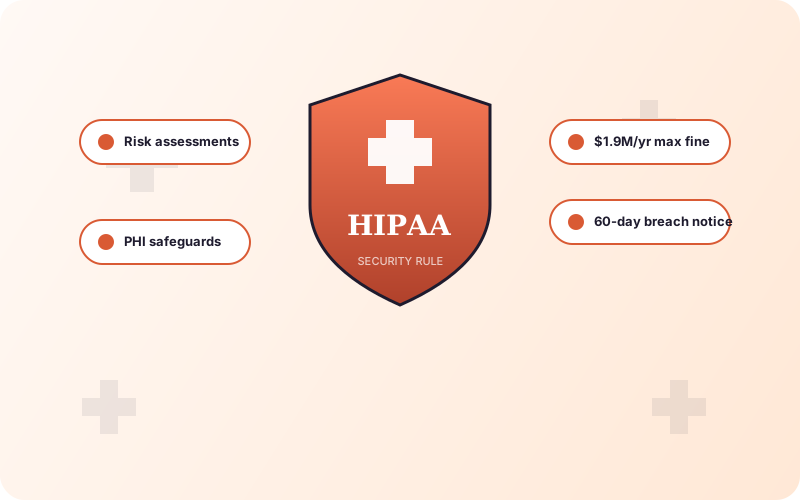
Applies to ePHI specifically. Requires administrative, physical, and technical safeguards. The home of MFA, encryption, audit logs, access controls, and risk analyses.
Breach Notification Rule
Requires notification to individuals, HHS, and (for 500+ breaches) the media within 60 days of discovery. Annual aggregate notification for sub-500 breaches.
HIPAA Security Rule safeguards
The Security Rule organises ~50 specifications into three categories. Until the 2025 NPRM finalises, many specifications are addressable (you can implement an alternative if you document why) — but in practice, OCR enforcement has treated most of them as required.
Administrative Safeguards (~9 standards)
- Security Management Process — including annual risk analysis (the #1 most-cited deficiency in OCR enforcement)
- Assigned Security Responsibility — designate a Security Officer
- Workforce Security & Information Access Management — onboarding/offboarding, least privilege
- Security Awareness & Training — including phishing simulations
- Security Incident Procedures, Contingency Plan, Business Associate Contracts, Periodic Evaluation
Physical Safeguards (~4 standards)
- Facility Access Controls — badge access, visitor logs, server room security
- Workstation Use & Security — locked screens, secure work-from-home setup
- Device & Media Controls — disposal, re-use, accountability, backups
Technical Safeguards (~5 standards)
- Access Control — unique user IDs, automatic logoff, encryption-decryption
- Audit Controls — record and examine system activity
- Integrity — protect ePHI from improper alteration or destruction
- Person or Entity Authentication — verify identity (MFA in practice)
- Transmission Security — encrypt ePHI in motion (TLS 1.2+)
2025 Security Rule NPRM — what's changing
In December 2024, HHS published the first major Security Rule update since 2013. The Notice of Proposed Rulemaking (NPRM) significantly raises the bar:
- End of "addressable": nearly all specifications become explicitly required
- MFA mandatory for all access to ePHI (with limited exceptions)
- Encryption by default for ePHI at rest and in transit
- Network segmentation required to limit lateral movement
- Vulnerability scanning every 6 months and pen-testing every 12 months
- Asset inventories and network maps updated at least annually
- 72-hour restoration capability for ePHI after incidents
- Annual compliance audits with written results
If finalised in 2025/2026, organisations will likely have 180 days to comply. Treat the NPRM as your floor today, not your ceiling tomorrow.
Step-by-step HIPAA compliance roadmap
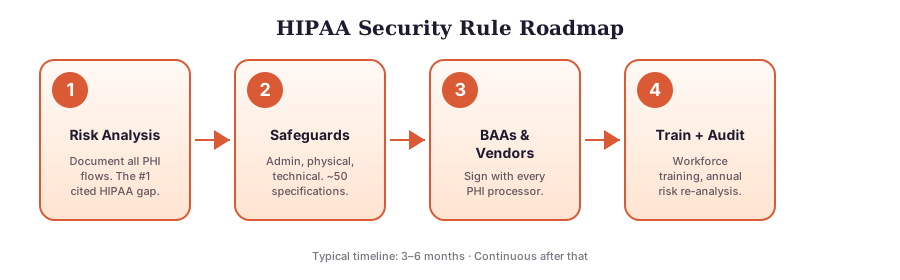
Phase 1 Assess (Weeks 1–3)
- Designate Privacy Officer and Security Officer
- Inventory all ePHI: where it lives, who has access, how it flows
- Conduct a HIPAA risk analysis using NIST SP 800-30 methodology
Phase 2 Document (Weeks 3–6)
- Policies & procedures library (admin, physical, technical safeguards)
- Workforce training programme + Notice of Privacy Practices
- Incident response plan + breach notification procedures
Phase 3 Implement (Weeks 4–12)
- Technical controls: MFA, encryption-at-rest and in-transit, audit logging, access reviews
- BAAs with every vendor processing PHI (cloud, EHR, comms, AI tools)
- Endpoint protection on every device with PHI access
Phase 4 Operate & Audit (Ongoing)
- Annual risk analysis re-do (a non-negotiable HIPAA requirement)
- Quarterly access reviews and audit log reviews
- Vulnerability scanning per the 2025 NPRM cadence
OCR penalties & enforcement examples
- Anthem (2018) — $16M settlement after a 2015 breach affecting 78.8M people. Root causes: failure to conduct enterprise-wide risk analysis, insufficient access reviews.
- Premera Blue Cross (2020) — $6.85M after 10.4M individuals' PHI was exfiltrated.
- Lifespan ACE (2020) — $1.04M after an unencrypted laptop was stolen, exposing 20K patients.
- L.A. Care Health Plan (2023) — $1.3M after multiple gaps including failure to conduct a risk analysis.
- Doctors' Management Services (2023) — $100K + 3-year CAP. The first ransomware-driven OCR settlement, citing inadequate risk analysis and audit controls.
Patterns: missing or stale risk analyses, no encryption on portable devices, BAAs that don't exist or aren't enforced, lack of audit log review.
Cost & timeline
Small practice / startup
3–6 months
Internal effort: ~120–200 hours. External support typically $10K–$40K one-off, then $1K–$3K/month for managed compliance + tooling.
Mid-size health tech / clinic group
6–9 months
Multi-team programme. External advisory + tooling: $40K–$120K including risk analysis, BAAs, technical controls, training. Ongoing: $3K–$10K/month.
Enterprise / hospital system
9–18 months
Often combined with HITRUST CSF or SOC 2. Programme work integrates with existing GRC; expect $120K+ external spend.
How Security Pulse helps with HIPAA
RunWay — Get compliant
- NIST 800-30 aligned risk analysis
- Policy library mapped to Privacy + Security + Breach rules
- BAA template library and vendor inventory
- Workforce training including HIPAA + phishing simulation
- Incident response runbook with 60-day breach path
Autopilot — Stay compliant
- MFA + encryption + access governance — NPRM-ready
- Endpoint protection on every device touching PHI
- 24/7 breach detection with Security Officer alerting
- Audit log retention and review automation
- OCR-ready evidence vault produced on demand
HIPAA vs HITRUST vs SOC 2
| HIPAA | HITRUST CSF | SOC 2 Type II | |
|---|---|---|---|
| Type | US Federal regulation | Private certification | Private attestation (AICPA) |
| Required by law? | Yes (for CEs/BAs) | No | No (contractually required) |
| Scope | PHI only | Multiple frameworks incl. HIPAA | Trust Services Criteria |
| External audit? | No formal audit, but OCR investigations | Yes — HITRUST-authorised assessor | Yes — CPA firm |
| Time to achieve | 3–6 months | 9–18 months | 6–12 months |
| Best for | All healthcare orgs (mandatory) | Health plans, large covered entities | SaaS / business associates selling to enterprise |