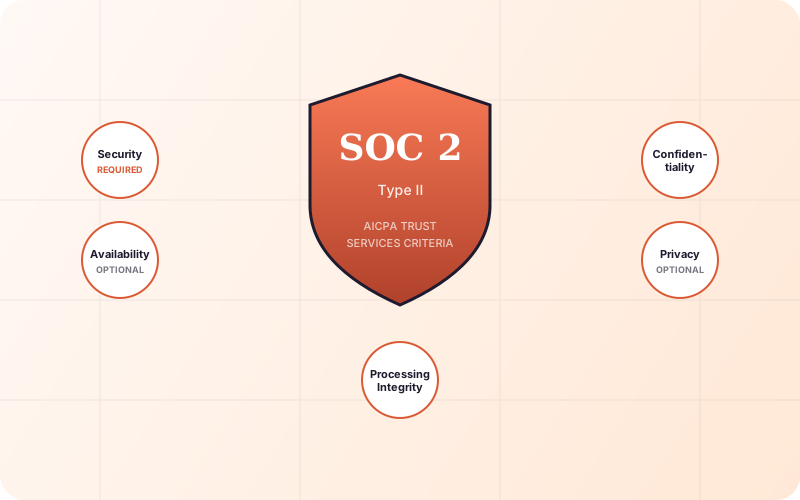
Who needs SOC 2?
SOC 2 is not a legal requirement — it is a contractual gate. The trigger is almost always the same: a prospective enterprise customer sends you a security questionnaire and asks for your SOC 2 report. If you don't have one, the deal stalls or dies.
- SaaS & cloud platforms — the canonical SOC 2 use case
- Data processors and analytics platforms
- Managed service providers (MSPs / MSSPs)
- Fintech, healthtech, and edtech — often alongside HIPAA, PCI DSS, or sector-specific frameworks
- AI/ML platforms — increasingly demanded by enterprise AI buyers
- Anyone selling to regulated buyers (banks, insurers, hospitals, government contractors)
The 5 Trust Services Criteria (TSCs)
Security (required)
Also called the Common Criteria. ~60 criteria covering control environment, risk assessment, access, change management, monitoring, and incident response. Required in every SOC 2 report.
Availability (optional)
Demonstrates your service meets uptime / performance commitments. Add this when you have SLAs.
Processing Integrity (optional)
System processing is complete, accurate, timely, and authorised. Common for payments, billing, healthcare claims, financial reporting platforms.
Confidentiality (optional)
Information designated confidential (customer data, IP, trade secrets) is protected through its lifecycle. Frequently added by B2B SaaS handling sensitive enterprise data.
Privacy (optional)
Personal information is collected, used, retained, disclosed, and disposed of in line with your privacy notice and applicable laws.
Most early-stage SOC 2 reports include Security only. You add additional TSCs when customers ask or when they're naturally relevant — adding Confidentiality is the most common second TSC.
What controls are tested?
The Common Criteria are organised into 9 series (CC1–CC9). Each maps to controls you need to design and operate. Typical control areas:
- CC1 — Control Environment: Org chart, code of conduct, board oversight, hiring/onboarding
- CC2 — Communication: Internal & external communication of policies, security commitments
- CC3 — Risk Assessment: Annual risk assessment, fraud risk consideration
- CC4 — Monitoring: Internal audits, control effectiveness reviews, deficiency tracking
- CC5 — Control Activities: Operating policies, segregation of duties
- CC6 — Logical & Physical Access: Identity, MFA, JIT access, access reviews, encryption
- CC7 — System Operations: Vulnerability management, monitoring, incident response, BCP/DR
- CC8 — Change Management: SDLC controls, change approval, code review, deployment
- CC9 — Risk Mitigation: Vendor risk management, business continuity, insurance
Step-by-step SOC 2 roadmap
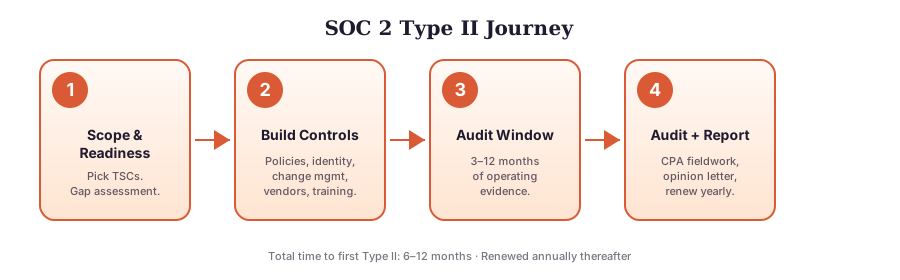
Phase 1 Scope & Readiness (Weeks 1–4)
- Select TSCs in scope (start with Security)
- Define system boundary: which products, environments, geographies
- Run a gap assessment against the Common Criteria
- Pick your auditor (engage early — calendars fill up)
Phase 2 Build Controls (Weeks 4–12)
- Policy library: security, access, change, vendor, incident response, BCP
- Identity controls: SSO, MFA, JIT access, quarterly access reviews
- Engineering controls: code review, branch protection, change approval, deployment logs
- Vendor inventory + DPAs; HR onboarding/offboarding workflows; mandatory training
Phase 3 Audit Window (3–12 months)
- Operate every control consistently for the observation period
- Capture evidence on a continuous basis (don't backfill in week 11)
- Track exceptions, remediate, and document
Phase 4 Audit + Report (Weeks 1–6 of year 2)
- Auditor fieldwork: control walkthroughs, evidence sampling, interviews
- Management response to any findings
- Final SOC 2 Type II report — share with prospects under NDA
The audit window — explained
SOC 2 Type II evaluates how your controls performed over time. The window is the period covered by the report:
- 3-month window: Common for a first Type II — gets you a real Type II report fastest
- 6-month window: A solid mid-point if you want longer coverage but don't want to wait a full year
- 12-month window: The standard from year 2 onwards. Sets you up for continuous annual coverage with no gaps
Practical implication: every control deficiency during the window must be remediated and documented. A failed quarterly access review, an offboarded employee whose accounts weren't disabled, an incident without a documented response — all of these can result in audit findings.
Cost & timeline
Startup / Series Seed–A
6–9 months
Type I + Type II in year 1. Auditor: $20K–$45K. Internal effort: 200–400 hours. Tooling + advisory: $10K–$30K. Total year-1 spend $30K–$80K.
Growth-stage SaaS
9–12 months
Type II with Security + Confidentiality. Auditor: $40K–$80K. Often combined with ISO 27001. Total: $80K–$200K including tooling and program management.
Enterprise SaaS
12+ months
Multi-TSC report with multiple subservice organisations. Auditor: $80K–$200K. Often part of a broader compliance portfolio (SOC 2 + ISO 27001 + HIPAA + FedRAMP).
How Security Pulse helps with SOC 2
RunWay — Get audit-ready
- Scoping workshop & TSC selection
- Common Criteria gap assessment
- Policy library aligned to all CC1–CC9 series
- Vendor inventory + DPA workflows
- Auditor selection + introductions
Autopilot — Operate continuously
- Identity, MFA, JIT access, quarterly access reviews
- Endpoint protection, EDR, vulnerability scanning
- Change management evidence captured automatically
- Incident response runbooks with audit trail
- Evidence vault — auditor-ready exports on demand
SOC 2 vs ISO 27001 vs HITRUST
| SOC 2 Type II | ISO 27001 | HITRUST CSF | |
|---|---|---|---|
| Type | Attestation report | Certification | Certification |
| Issuer | Licensed CPA firm | Accredited certification body | HITRUST-authorised assessor |
| Geography | US-led, accepted globally | Global standard | US (especially healthcare) |
| Validity | 12 months | 3 years (annual surveillance) | 2 years |
| Report style | Public-by-NDA written report | Certificate + scope statement | Letter + assessment report |
| Best for | SaaS selling to US enterprise | Global enterprise, EU/Asia | Health plans, large CEs/BAs |
Top 5 SOC 2 mistakes
- Backfilling evidence at the end of the window. Auditors can tell. Capture continuously.
- Picking the wrong scope. Excluding production systems to "make it easier" — buyers will notice.
- Treating SOC 2 as a one-time project. It's annual. Build operating cadence from day one.
- Skipping access reviews. The single most common audit finding.
- Engaging an auditor too late. Top firms book out 3–6 months ahead.