Who needs ISO 27001?
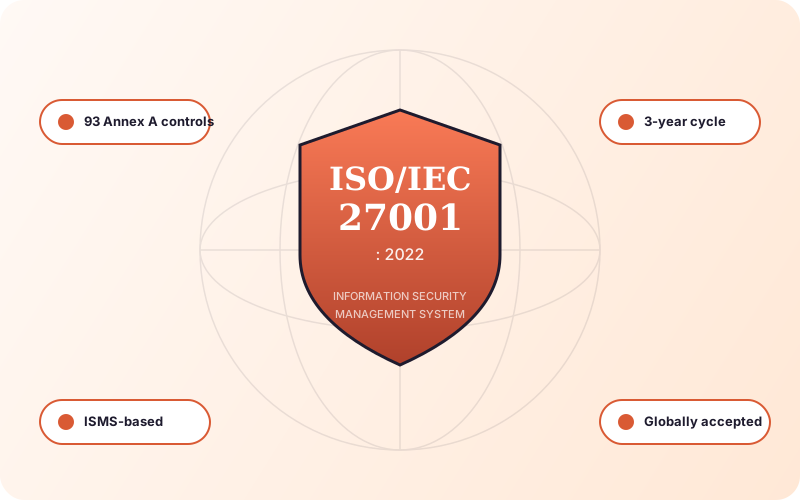
ISO 27001 is the most widely recognised international information security certification. While not legally mandatory, it is increasingly the price of entry to global enterprise sales:
- SaaS and cloud providers selling internationally
- Financial services — banks, insurers, fintechs (often alongside regional regulators)
- Healthtech and life sciences handling cross-border data
- Managed service providers / MSSPs / SOC providers
- Government and public-sector suppliers (especially in EU, UK, Singapore, UAE)
- Manufacturers and supply-chain organisations facing customer security questionnaires
If a single significant deal is conditional on ISO 27001, you have a business case. If multiple deals are at risk, you have an emergency.
The ISMS — clauses 4 to 10
ISO 27001's body specifies the requirements for your Information Security Management System (ISMS). Clauses 4–10 are mandatory:
Context of the organisation
Define internal/external issues, interested parties, and the scope of your ISMS.
Leadership
Top-management commitment, security policy, roles & responsibilities.
Planning
Risk assessment, risk treatment, security objectives — the analytical core.
Support
Resources, competence, awareness, communication, documented information.
Operation
Operational planning and control; risk treatment plan execution.
Performance evaluation
Monitoring, internal audit, management review.
Improvement
Nonconformity management, corrective actions, continual improvement.
Annex A — 93 controls in 4 themes
The 2022 revision restructured Annex A from 14 domains into 4 themes:
| Theme | Controls | Examples |
|---|---|---|
| A.5 Organisational | 37 | Information security policies, roles, threat intelligence, supplier security, classification, identity management, incident management |
| A.6 People | 8 | Screening, terms of employment, awareness/training, disciplinary process, remote working, NDAs |
| A.7 Physical | 14 | Physical security perimeter, secure areas, equipment placement, secure disposal, clear desk/screen |
| A.8 Technological | 34 | User endpoints, privileged access, secure authentication, cryptography, backup, logging, web filtering, secure coding, vulnerability management |
11 new controls were added in 2022 — including A.5.7 Threat intelligence, A.5.23 Cloud services security, A.8.9 Configuration management, A.8.10 Information deletion, A.8.11 Data masking, A.8.12 DLP, A.8.16 Monitoring activities, A.8.23 Web filtering, A.8.28 Secure coding, A.5.30 ICT readiness for BCM, A.7.4 Physical security monitoring.
The Statement of Applicability (SoA)
Your SoA is the most-referenced document during certification. It lists every Annex A control with one of three states:
- Implemented — describe how, with reference to your evidence and policies
- Excluded — explain why (e.g. "no on-premise data centres" → exclude certain physical controls)
- Not yet implemented — for controls planned in your treatment roadmap
Every entry must be justified by your risk assessment and treatment plan. The two documents read together. Auditors will sample heavily across both.
Step-by-step certification roadmap
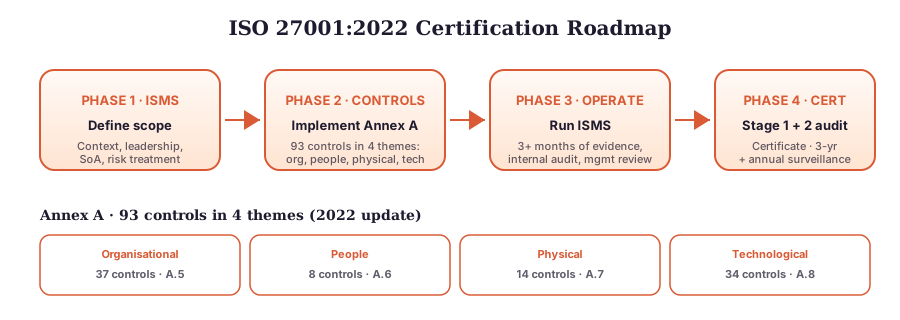
Phase 1 Build the ISMS (Months 1–3)
- Define scope (which products, sites, services, geographies)
- Engage leadership; establish security policy + roles
- Run a risk assessment and produce the risk treatment plan
- Draft the Statement of Applicability
Phase 2 Implement Annex A controls (Months 2–6)
- Build out the 93 controls in scope (organisational, people, physical, technological)
- Policy library, training programme, vendor management, incident response
- Technical baselines: identity, MFA, encryption, logging, backups, monitoring
Phase 3 Operate the ISMS (Months 4–9)
- Generate at least 3 months of operating evidence
- Conduct an internal audit covering all clauses + a sample of controls
- Hold a management review with documented outputs
- Engage your certification body and book Stage 1
Phase 4 Certification audits (Months 9–12)
- Stage 1: documentation & ISMS readiness
- Stage 2: on-site/remote fieldwork — control testing, interviews, evidence sampling
- Address any non-conformities; receive certificate
- Annual surveillance audits in years 1 + 2; recertification at year 3
Stage 1, Stage 2, and surveillance
Understanding the audit cycle is critical:
- Stage 1 (Documentation review): 1–3 days. The auditor reviews your scope, policies, SoA, risk assessment, internal audit programme, and management review records. Output is a list of issues to address before Stage 2.
- Stage 2 (Certification audit): 3–10+ days depending on size. The auditor tests implementation and effectiveness — interviews, observation, evidence sampling. They issue findings classified as major non-conformities (must be remediated before certificate), minor non-conformities (remediated post-cert), and opportunities for improvement.
- Annual surveillance audits: 1–3 days each in years 1 and 2. Sample of controls and ISMS operation.
- Recertification (year 3): Comprehensive — closer in scope to the original Stage 2.
Cost & timeline
Small SaaS (1–50 staff)
9–12 months
Cert body: $15K–$30K. Advisory/tools: $10K–$25K. Internal: 300–500 hrs. Year 1 total $30K–$70K. Surveillance: ~$10K/year.
Mid-market (50–500 staff)
12–15 months
Cert body: $30K–$60K. Advisory: $25K–$60K. Internal: 600–1000 hrs. Total $80K–$180K. Often combined with SOC 2 to share evidence.
Enterprise / multi-site
15–24 months
Multi-site sampling. Cert body: $60K–$200K. Programme work: $100K+. Often part of a portfolio (ISO 27001 + 27017 + 27018 + 27701).
How Security Pulse helps with ISO 27001
RunWay — Build the ISMS
- Scope, risk assessment & risk treatment plan
- Statement of Applicability template + control mapping
- Policy library covering all 93 Annex A controls
- Internal audit programme + management review templates
- Certification body selection support
Autopilot — Operate continuously
- Identity, MFA, JIT access, quarterly access reviews (A.5, A.8)
- Endpoint protection + vulnerability management (A.8)
- Incident response with documented runbooks (A.5.24–A.5.27)
- Vendor risk monitoring (A.5.19–A.5.23)
- Evidence vault — exports for surveillance + recertification
ISO 27001 vs SOC 2
| ISO 27001:2022 | SOC 2 Type II | |
|---|---|---|
| Type | Certification (international standard) | Attestation report (US, AICPA) |
| Validity | 3 years (annual surveillance) | 1 year (annual renewal) |
| Best for | Global enterprise, EU/Asia buyers, gov suppliers | US enterprise SaaS sales |
| Audit cost | $15K–$60K (small/mid) | $20K–$80K (small/mid) |
| Time to first cert/report | 9–18 months | 6–12 months |
| Output | Certificate + scope statement | Detailed written report (under NDA) |
| Overlap | ~80% of controls overlap — most companies share evidence between both | |