Who needs to comply with GDPR?
GDPR has the broadest territorial scope of any data-protection law. You are in scope if any of the following apply:
- Your organisation is established in the EU or EEA, regardless of where you process personal data
- You offer goods or services to individuals in the EU/EEA (paid or free) — explicit targeting matters: a checkout in EUR, an EU language, a "ships to Europe" page
- You monitor the behaviour of EU individuals — analytics, advertising tracking, behaviour profiling
- You are a processor handling personal data on behalf of any of the above (most SaaS vendors)
The UK GDPR applies almost identically to UK residents post-Brexit. Most multinational businesses operate a single GDPR programme that covers both — the practical differences are minor and largely about which supervisory authority you deal with (an EU national DPA vs the UK ICO).
The 7 GDPR principles (Article 5)
Lawfulness, fairness, transparency
Process data on a documented lawful basis. Tell people clearly what you're doing.
Purpose limitation
Collect for specified, explicit, legitimate purposes. No silent repurposing.
Data minimisation
Adequate, relevant, limited to what is necessary. If you don't need it, don't collect it.
Accuracy
Keep personal data accurate; correct or erase inaccurate data without delay.
Storage limitation
Retain only as long as necessary. Defined retention schedules required.
Integrity and confidentiality
Article 32 security: encryption, MFA, access controls, resilience, regular testing.
Accountability
The controller must demonstrate compliance with all of the above. Documentation is the proof.
The 8 data subject rights
- Right to be informed — clear privacy notice at the point of collection (Art. 13/14)
- Right of access (DSAR) — confirm what data you hold and provide a copy (Art. 15)
- Right to rectification — correct inaccurate or incomplete data (Art. 16)
- Right to erasure / "right to be forgotten" (Art. 17) — limited to defined grounds
- Right to restrict processing (Art. 18)
- Right to data portability — structured, common-format export (Art. 20)
- Right to object — including the absolute right to object to direct marketing (Art. 21)
- Rights related to automated decision-making and profiling (Art. 22)
Most requests must be handled within one calendar month, free of charge (with limited exceptions for excessive or repetitive requests). You need a documented DSAR intake, identification verification, search-and-redaction workflow, and response template.
Lawful bases for processing (Article 6)
Every processing activity needs a documented lawful basis. The six options:
- Consent — must be freely given, specific, informed, unambiguous, with a positive opt-in. Pre-ticked boxes don't count.
- Contract — necessary for the performance of a contract with the data subject (or pre-contractual steps)
- Legal obligation — required by EU/Member State law
- Vital interests — narrow: protecting life
- Public task — for public authorities and certain official functions
- Legitimate interests — your legitimate interests, balanced against the rights and freedoms of the data subject (Legitimate Interests Assessment / LIA required)
For special category data (race, health, biometric, sexual orientation, religion, political opinion, genetic, trade-union membership), Article 9 imposes additional conditions on top of the Article 6 basis.
DPIAs, DPOs and DPAs
Data Protection Impact Assessment (DPIA)
Article 35 requires a DPIA before any processing likely to result in a high risk to individuals. Mandatory triggers include systematic profiling with legal/significant effects, large-scale processing of special category data, and large-scale public monitoring. Even where not strictly required, DPIAs are best practice for any new product or processing change.
Data Protection Officer (DPO)
Article 37 requires a DPO if you are a public authority, your core activities involve large-scale regular and systematic monitoring, or your core activities involve large-scale special category data. The DPO must be independent, expert, report to top management, and be reachable by data subjects and the supervisory authority.
Data Processing Agreement (DPA)
Article 28 requires a written DPA between a controller and any processor handling personal data on its behalf. The DPA must address eight specific commitments — most major SaaS vendors offer a standard GDPR DPA (often as an addendum or click-through) you can sign on import.
International transfers (post-Schrems II)
Transferring EU/EEA personal data outside the EEA requires a valid Article 46 mechanism. Since the Schrems II ruling (2020), you must also assess whether the destination jurisdiction provides equivalent protection in practice — a Transfer Impact Assessment (TIA).
- Adequacy decisions — UK, Switzerland, Japan, South Korea, New Zealand, Argentina, Canada (commercial), and the EU–US Data Privacy Framework (for participating US importers)
- Standard Contractual Clauses (SCCs) — 2021 modular SCCs are the most common path
- Binding Corporate Rules (BCRs) — for intragroup transfers
- Article 49 derogations — narrow, exceptional, not for routine transfers
Step-by-step GDPR compliance roadmap
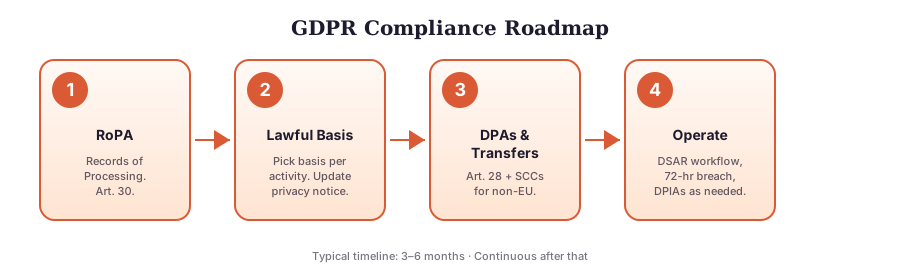
Phase 1 Map (Weeks 1–3)
- Build the Records of Processing Activities (RoPA) — Article 30 register
- Identify lawful basis for every activity
- Map all data flows including third-party recipients and international transfers
Phase 2 Notice & Bases (Weeks 3–6)
- Update privacy notice with Article 13/14 disclosures
- Implement consent mechanisms (cookie banner, marketing preferences)
- Document Legitimate Interests Assessments where used
Phase 3 Contracts & Transfers (Weeks 4–10)
- Sign DPAs with every processor
- Implement SCCs + Transfer Impact Assessments for non-EU transfers
- Update internal data sharing arrangements (controller-to-controller, joint controllers)
Phase 4 Operate (Ongoing)
- DSAR intake and 30-day response workflow
- 72-hour breach notification process
- Article 32 security controls (encryption, MFA, monitoring, testing)
- DPIAs for new products / significant changes
Real fines & enforcement
- Meta — €1.2B (2023) — unlawful EU–US transfers (Irish DPC)
- Amazon — €746M (2021) — advertising consent failures (Luxembourg CNPD)
- Instagram — €405M (2022) — children's data exposure (Irish DPC)
- TikTok — €345M (2023) — children's data processing
- British Airways — £20M (2020) — security failures leading to a 400K-record breach
Smaller, more common cases routinely run from €5K to €1M for SMEs — most often for failure to maintain a RoPA, missing or inadequate privacy notices, no lawful basis for marketing, or missing DPAs with vendors.
How Security Pulse helps with GDPR
RunWay — Get compliant
- RoPA template and lawful basis registry
- DPIA + LIA templates and workflow
- DPA library + Schrems II Transfer Impact Assessment
- Privacy notice generator and consent management guidance
- DSAR intake and 30-day response runbook
Autopilot — Stay compliant
- Article 32 controls — encryption, MFA, access governance
- Endpoint protection on every device touching EU data
- 72-hour breach detection and notification path
- Vendor monitoring with DPA tracking
- Evidence vault — supervisory-authority-ready exports
GDPR vs PDPA vs CCPA
| GDPR (EU/UK) | PDPA (Singapore) | CCPA / CPRA (California) | |
|---|---|---|---|
| Scope | EU/UK personal data, global reach | Singapore personal data | California consumer data, threshold-based |
| Max fine | €20M or 4% global turnover | S$1M or 10% local turnover | Up to $7,500 per intentional violation |
| Breach window | 72 hours | 3 calendar days | "Without unreasonable delay" |
| DPO required | Conditional | Yes — every org | Not required |
| Right to be forgotten | Yes | No | Right to delete (limited) |
| Approach | Rights-based, principles-driven | Principles + consent-based | Consumer-rights-based |