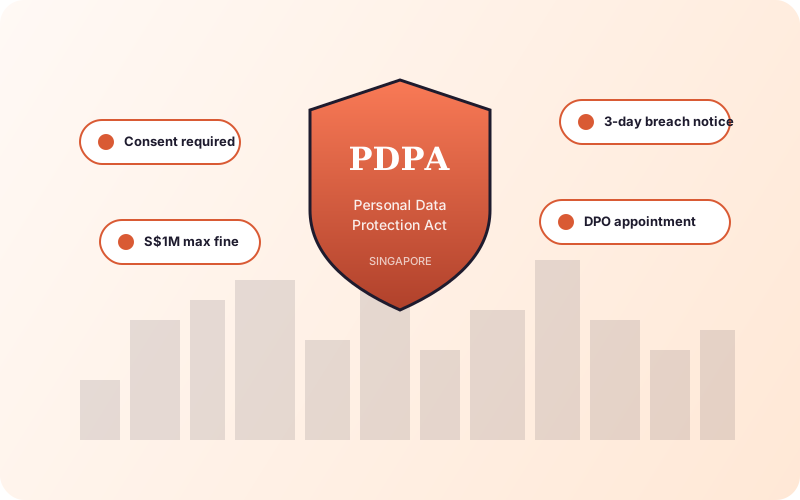
Who needs to comply with PDPA?
Every private-sector organisation that collects, uses, or discloses personal data about an individual in Singapore must comply with PDPA — regardless of where the organisation is headquartered or where its servers live. A US SaaS company with one Singapore customer is in scope. A Singapore-incorporated holding company processing data of EU residents is also in scope (alongside GDPR).
"Personal data" is broadly defined: any data, true or false, about an individual who can be identified — name, NRIC, email, phone, IP address, photo, voice recording, behavioural profile, employee record, or any combination that identifies a person.
- SMEs and startups — no exemptions based on size or revenue
- Multinationals with Singapore operations or customers
- SaaS, platforms and marketplaces serving Singapore users
- Healthcare, fintech, edtech, e-commerce — typically high-risk categories
- Data intermediaries (vendors processing data on your behalf) have a narrower set of obligations but are still in scope
Public sector agencies are governed by the Public Sector (Governance) Act rather than PDPA, but vendors providing services to government must usually meet equivalent or stricter standards.
The 9 PDPA data protection obligations
PDPA's heart is a set of nine principles-based obligations. You must operationalise each one with policies, processes, and technical controls.
Consent
Collect, use, and disclose personal data only with valid consent — or under a recognised exception (legitimate interests, business asset transactions, etc.).
Purpose Limitation
Use data only for purposes a reasonable person would consider appropriate and that the individual has been notified of.
Notification
Tell individuals the purposes for which their data is being collected, used, or disclosed — at or before collection.
Access & Correction
Provide individuals with access to their personal data on request and let them correct errors.
Accuracy
Make a reasonable effort to ensure personal data is accurate and complete, especially when used for decisions about the individual.
Protection
Implement reasonable security arrangements — encryption, access controls, MFA, endpoint security, vendor due diligence, employee training.
Retention Limitation
Cease retention or anonymise personal data when the original purpose is no longer being served, and there's no other legal/business reason to keep it.
Transfer Limitation
Personal data transferred outside Singapore must receive a comparable standard of protection (contractual clauses, BCRs, certifications).
Openness
Develop and publish data protection policies. Appoint and publish DPO contact details. Make practices transparent to individuals.
Three additional obligations were added in the 2020 PDPA Amendment: Accountability (formerly Openness), Mandatory Data Breach Notification, and the Data Portability Obligation (in force only when subsidiary legislation is issued).
Data Protection Officer (DPO)
Appointing at least one DPO is mandatory for every organisation — there is no exemption based on size, revenue, or industry. The DPO is your accountable person for PDPA: they oversee compliance, handle access/correction requests, manage breach response, and act as the primary point of contact for the PDPC.
- The DPO can be an internal employee (often the founder, COO, head of operations, or IT lead in smaller orgs)
- It can be an outsourced or virtual DPO from a qualified service provider
- The contact details must be published (typically a dedicated page or footer link) and registered with ACRA via the Practitioners Certificate of Insurance filing
- The DPO does not need to be a lawyer but should be trained — the IMDA's Practitioner Certificate in Personal Data Protection (PCPDP) is widely recognised
Mandatory data breach notification
Since 1 February 2021, organisations have a statutory duty to notify the PDPC of data breaches that meet either of these tests:
- Significant harm — the breach results in, or is likely to result in, significant harm to affected individuals (financial loss, identity theft, etc.)
- Significant scale — the breach affects 500 or more individuals
The deadlines:
- To the PDPC: as soon as practicable and no later than 3 calendar days from when you have reason to believe a notifiable breach has occurred
- To affected individuals: at the same time or shortly after — unless an exception applies (e.g. the data was rendered unintelligible by encryption, or notification would impede a criminal investigation)
Practical implication: you need a tested incident response plan, breach assessment template, communication templates, and a single owner who can authorise notifications inside 72 hours. These don't appear from nowhere on day-of.
Step-by-step PDPA compliance roadmap
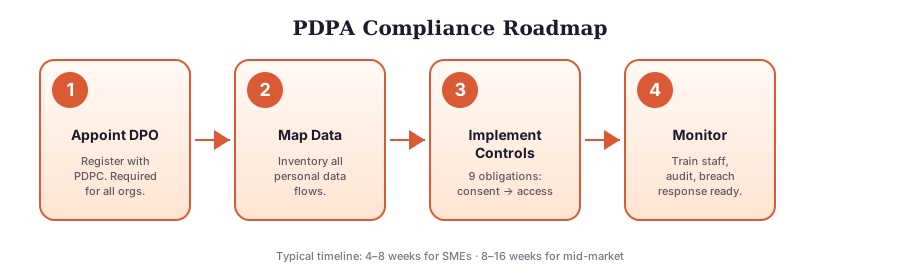
A defensible compliance baseline can be reached in 4–8 weeks for most SMEs. The work falls into four phases:
Phase 1 Govern (Weeks 1–2)
- Appoint and publish DPO contact details
- Run a data inventory: what personal data, where it lives, who can access it, where it's transferred
- Risk-assess each data flow against the 9 obligations
Phase 2 Document (Weeks 2–4)
- Publish public-facing privacy policy and notification statements
- Internal policies: data protection policy, retention schedule, vendor due-diligence policy, access request handling SOP
- Build the Data Protection Management Programme (DPMP) — the PDPC's recommended governance artefact
Phase 3 Protect (Weeks 3–6)
- Technical controls: MFA, encryption-in-transit and at-rest, endpoint protection, identity governance, logging
- Vendor risk reviews and updated DPAs (Data Processing Agreements)
- Mandatory staff training (annual refreshers expected)
Phase 4 Respond & Improve (Ongoing)
- Tested incident response plan with 3-day PDPC notification path
- Quarterly access reviews, annual policy refresh
- Continuous monitoring for new data flows, vendors, and processing activities
Real penalties & enforcement examples
The PDPC publishes its enforcement decisions. They are a far better guide to what "compliance" actually looks like than the Act itself. Notable cases:
- SingHealth / IHiS (2019) — S$1,000,000 in combined fines following the breach affecting 1.5M patients. Root cause: weak account management, unpatched systems, slow incident response.
- Commeasure / RedDoorz (2022) — S$74,000 fine after the personal data of 5.9M customers was exposed via an AWS access key embedded in an Android APK.
- MyRepublic (2022) — S$60,000 fine after 79,388 customers' data was exfiltrated from a third-party data storage facility with insufficient access controls.
- Recurring DNC violations — multiple SMEs fined S$10K–S$50K per case for sending marketing messages without checking the Do Not Call registry.
Beyond financial penalties, the PDPC routinely issues directions requiring organisations to undertake remedial work (often more costly than the fine itself), and enforcement decisions are publicly named — the reputational impact often exceeds the cash fine.
“The PDPC's enforcement decisions are a far better guide to what compliance actually looks like than the Act itself. Read three of them and you'll know which controls to invest in first.”
— Security Pulse compliance team
Cost & timeline
SME (1–50 staff)
4–8 weeks
Internal effort: ~80–120 hours of DPO/founder time. External support (policies, training, technical setup): typically S$5K–S$25K one-off, then S$500–S$2K/month for ongoing monitoring.
Mid-market (50–500 staff)
8–16 weeks
Multi-departmental effort. External programme: S$25K–S$80K including DPMP, technical controls, vendor reviews, training. Ongoing: S$2K–S$8K/month.
Enterprise (500+)
16+ weeks
Programme work integrating with existing GRC. External advisory + tooling typically S$80K+. Often combined with ISO 27001 or Cyber Trust Mark for portfolio coverage.
How Security Pulse helps with PDPA
Security Pulse is built around the 9 PDPA obligations from the ground up. We provide both the foundational programme and the continuous controls in a single platform — so PDPA compliance isn't a one-off project that decays after audit.
RunWay — Get compliant
- DPO advisory and registration support
- Data inventory & flow mapping workshop
- Policy library aligned to PDPC's DPMP
- Staff training programme with PDPA-specific content
- Incident response runbook with 3-day PDPC path
Autopilot — Stay compliant
- Identity & access controls (MFA, JIT access, quarterly reviews)
- Endpoint protection on every device with Singapore data
- Email & cloud security covering the most-exploited paths
- 24/7 breach detection with auto-alerting to your DPO
- Evidence vault — produces PDPC-ready reports on demand
PDPA vs GDPR vs HIPAA
| PDPA (Singapore) | GDPR (EU/UK) | HIPAA (US) | |
|---|---|---|---|
| Scope | All Singapore personal data | EU/UK resident personal data | US Protected Health Information (PHI) |
| Max fine | S$1M or 10% turnover | €20M or 4% global turnover | $1.9M/yr per category |
| Breach window | 3 calendar days to PDPC | 72 hours to supervisory authority | 60 days to HHS & individuals |
| DPO required | Yes — every organisation | Conditional (high-risk processing) | Privacy & Security Officers required |
| Right to be forgotten | No (not yet) | Yes (Art. 17) | Limited (correction rights) |
| Cross-border transfer | Comparable protection required | Adequacy / SCCs / BCRs | Less restrictive (BAAs) |