The global average breach lifecycle is 241 days. The average SOC 2 audit covers a 12-month window and produces a report a month after the period ends. Do the math, and there's a 270-plus-day gap between when a control fails and when an auditor tells you about it. Continuous compliance monitoring exists to close that gap, and in 2026 it stopped being a nice-to-have. PCI DSS v4.0 made it mandatory in March 2025. NIST 800-53 has required it under the CA-7 control family for over a decade. FedRAMP built an entire Continuous Monitoring program around it. Every modern GRC platform is racing to automate it.
This guide covers what continuous compliance monitoring actually is at the architecture level, which frameworks require it, the 11 tools you should evaluate in 2026, how to implement it without blowing out your security budget, and the specific playbooks for GDPR, HIPAA, and zero trust environments. It's written for security leaders, MSSPs, and vCISOs who run compliance for real, not for content marketing teams.
If you want the broader view, start with our 2026 cybersecurity compliance guide. This post is the deep dive on the monitoring layer.
What continuous compliance monitoring actually is
Continuous compliance monitoring is the automated, ongoing verification that security controls remain effective and aligned with regulatory requirements, delivered through real-time telemetry, rule-based evaluation, and evidence capture. It replaces the old model of gathering evidence manually in the six weeks before an auditor arrives.
The word "continuous" does real work in that definition. It distinguishes the practice from "periodic monitoring" (monthly, quarterly) and from "event-based monitoring" (something triggers a check). True continuous monitoring evaluates controls on a schedule measured in minutes or hours, not days or weeks, and it produces timestamped evidence that an auditor can review in real time.
The term is sometimes used interchangeably with continuous control monitoring (CCM), continuous controls monitoring, and continuous compliance. For practical purposes they refer to the same operational pattern: automated, always-on verification of controls against framework requirements with alerting on drift and audit-ready evidence capture.
How continuous compliance monitoring works: the 4-layer architecture
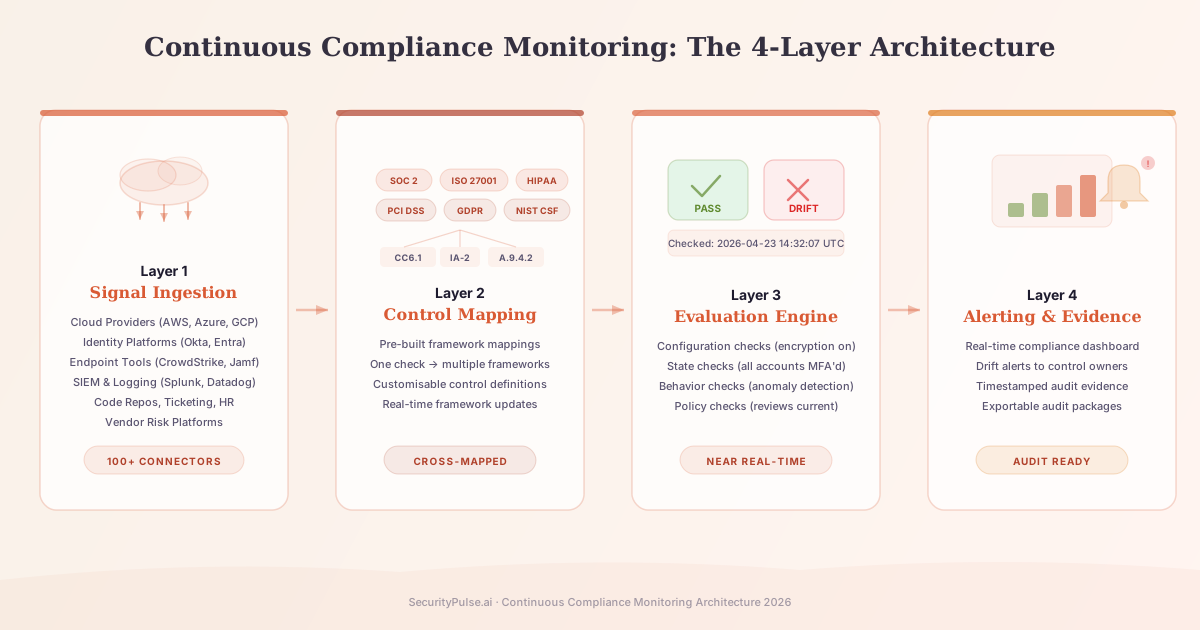
Every such system has the same underlying architecture, whether you build it or buy it. Understanding the four layers lets you evaluate tools honestly and spot gaps in your own program.
Layer 1: Signal ingestion
The platform collects telemetry from the systems where your controls live. Typical sources:
- Cloud providers (AWS Config, Azure Policy, GCP Security Command Center) for infrastructure configuration
- Identity platforms (Okta, Entra ID, Google Workspace) for access control evidence
- Endpoint tools (CrowdStrike, SentinelOne, Jamf, Intune) for device posture
- SIEM and logging (Splunk, Datadog, Elastic, Chronicle) for event data
- Code repositories (GitHub, GitLab, Bitbucket) for change management and SDLC controls
- Ticketing (Jira, ServiceNow) for incident response and change approval evidence
- HR systems (BambooHR, Rippling, Workday) for onboarding and offboarding controls
- Vendor risk platforms (SecurityScorecard, Bitsight, UpGuard) for third-party posture
A serious tool connects to 100-plus of these. A weak one connects to 15 and expects you to upload evidence manually for the rest.
Layer 2: Control mapping
Raw signals are useless until they're mapped to controls in a compliance framework. This layer maintains the relationship between a technical check (e.g., "MFA enabled for all privileged accounts in Entra ID") and a framework control (SOC 2 CC6.1, ISO 27001 A.9.4.2, NIST 800-53 IA-2, etc.). Good platforms ship pre-built mappings for major frameworks. Great platforms let you customise them and share mappings across frameworks so one technical check satisfies five control requirements simultaneously.
Layer 3: Evaluation
The evaluation engine runs checks against the ingested signals on a defined cadence. The checks can be:
- Configuration checks: Is this setting present, is encryption enabled, is logging on
- State checks: Are all accounts MFA-enabled, are backups completing, is patching current
- Behavior checks: Is someone accessing data outside normal hours, is lateral movement occurring
- Policy checks: Have required reviews happened in the last quarter, are vendor risk assessments current
Each check produces a pass/fail result, a timestamp, and a reference to the source signal.
Layer 4: Alerting and evidence capture
When a check fails, the system generates an alert with context. When a check passes, it captures that result as evidence for the next audit. Mature platforms produce a real-time compliance dashboard showing overall posture, control drift over time, and exportable audit-ready evidence packages. This layer is where most tools differentiate themselves, since ingestion and mapping are increasingly commoditised.
Why continuous compliance monitoring matters in 2026
The business case has hardened over the last 24 months.
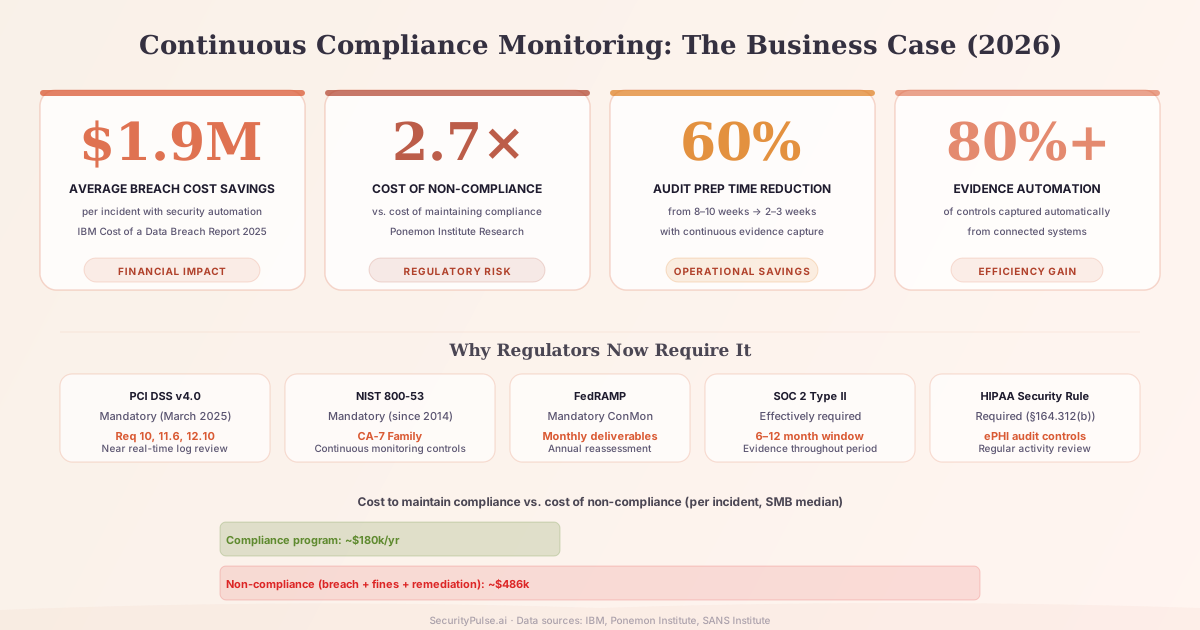
Regulators now expect it. PCI DSS v4.0 explicitly requires continuous monitoring as of March 2025. NIST 800-53 has required it under the CA-7 Continuous Monitoring control family since 2014. FedRAMP built an entire Continuous Monitoring (ConMon) program around it. ISO 27001:2022 strengthened monitoring requirements in Annex A. The regulatory signal is consistent: point-in-time snapshots are insufficient.
The financial delta is real. IBM's 2025 Cost of a Data Breach Report shows organisations using extensive security automation saved $1.9 million per breach compared to organisations that didn't. Ponemon's Cost of Compliance vs. Non-Compliance research puts the average cost of non-compliance at roughly 2.7 times the cost of maintaining compliance. Both numbers point to continuous monitoring as the highest-leverage investment for reducing breach cost and compliance spend simultaneously.
Audit overhead is crushing teams. Internal security and compliance staff routinely report spending 40-60% of their time in the two months before an audit gathering evidence manually. Continuous compliance monitoring compresses that overhead because evidence is already timestamped and collected. The typical audit preparation time drops from 8-10 weeks to 2-3 weeks once automation is in place.
Enterprise customers are requiring it in contracts. Master Services Agreements from Fortune 500 buyers increasingly include clauses requiring their vendors to maintain continuous monitoring of specific control domains (access, change management, vulnerability management). Without it, you're losing contracts at procurement.
Compliance frameworks that require or strongly recommend continuous monitoring
Framework-specific monitoring requirements matter because auditors will check them explicitly. Here's the practical mapping.
| Framework | Requirement Level | Specific Control | Observation Cadence |
|---|---|---|---|
| PCI DSS v4.0 | Mandatory (March 2025+) | Req 10, 11.6, 12.10 | Near real-time for critical logs |
| NIST 800-53 | Mandatory | CA-7 Continuous Monitoring family | Organization-defined, typically daily |
| NIST CSF 2.0 | Recommended (DE.CM) | Detect function | Continuous |
| FedRAMP | Mandatory | ConMon program | Monthly reports, annual reassessment |
| SOC 2 Type II | Effectively required | 6–12 month observation window | Throughout observation period |
| ISO 27001:2022 | Required | A.8.16 Monitoring activities | Defined in ISMS |
| HIPAA Security Rule | Required | §164.308(a)(1)(ii)(D), §164.312(b) | Regular review |
| GDPR Article 32 | Required | Ongoing CIA of processing | Regular testing |
| CMMC 2.0 | Mandatory | SI.L2-3.14.6, AU.L2-3.3.5 | Continuous |
| NIS2 Directive | Required (EU) | Article 21 risk management | Ongoing |
PCI DSS v4.0 continuous monitoring requirements
Version 4.0, fully mandatory since March 31, 2025, introduced the most explicit continuous monitoring requirements in PCI history. Requirement 10 now demands automated log review, near real-time alerting on critical events, and daily review of security events. Requirement 11.6 requires a change- and tamper-detection mechanism that alerts personnel to unauthorized modification of payment pages. Requirement 12.10 requires continuous documentation and real-time incident response readiness.
NIST 800-53 CA-7
The Continuous Monitoring control family is the gold standard for how continuous monitoring should be structured. Sub-controls cover establishing metrics (CA-7(a)), monitoring frequencies (CA-7(b)), ongoing assessments (CA-7(c)), correlation and analysis (CA-7(d)), response actions (CA-7(e)), and reporting (CA-7(f)). If you implement CA-7 rigorously, you satisfy the continuous monitoring requirements of most other frameworks simultaneously.
SOC 2 Type II
SOC 2 doesn't use the words "continuous monitoring" in its Trust Services Criteria, but Type II attestation requires evidence of control operation throughout a 6-12 month observation window. Manually producing that evidence for 60-100 controls across 10 systems for 12 months is impossibly expensive. Continuous compliance monitoring is the only scalable way to satisfy a modern SOC 2 Type II audit.
HIPAA Security Rule
45 CFR §164.308(a)(1)(ii)(D) requires a security management process that includes "regular review" of system activity. §164.312(b) requires audit controls that record and examine activity in systems containing ePHI. The Office for Civil Rights has increasingly cited the absence of continuous monitoring in HIPAA enforcement actions.
FedRAMP ConMon
Authorized cloud service providers must submit monthly continuous monitoring deliverables including vulnerability scans, inventory updates, POA&M updates, and incident reports. Annual reassessment verifies a third of the 325 moderate-baseline controls each year. Miss a monthly ConMon deliverable and your authorization goes on notice.
What to monitor: the control categories
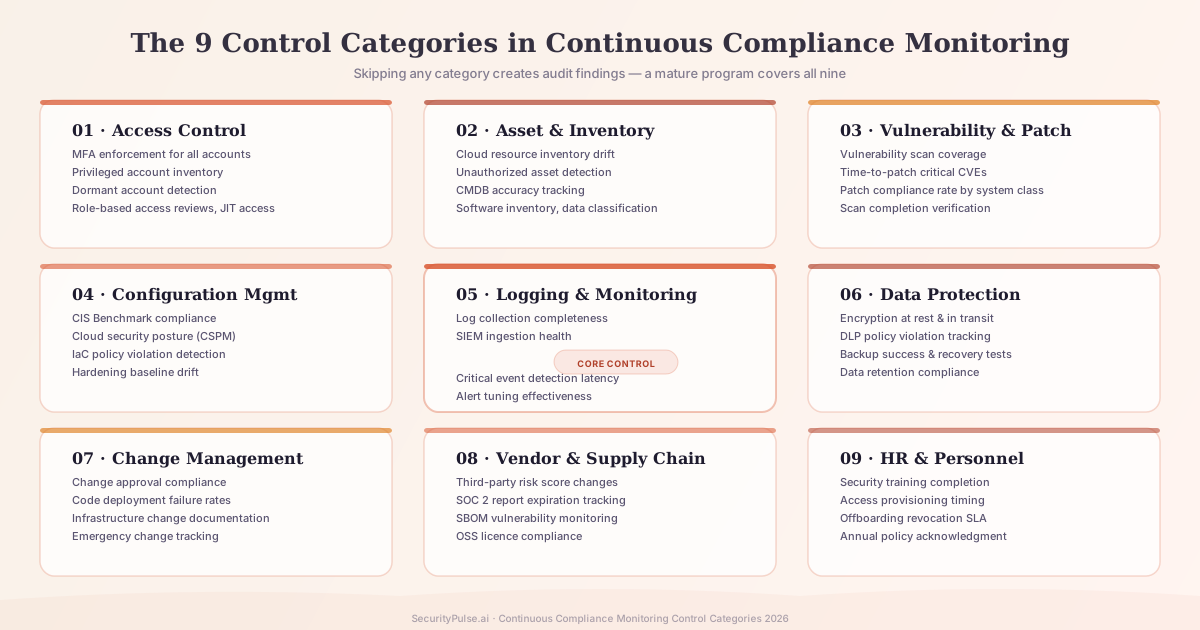
A mature program covers controls across nine categories. Skipping any of these creates audit findings.
- Access control. MFA enforcement, privileged account inventory, dormant account detection, role-based access review, just-in-time access, service account governance.
- Asset and inventory management. Cloud resource inventory drift, unauthorized asset detection, CMDB accuracy, software inventory, data classification tagging.
- Vulnerability and patch management. Vulnerability scan completion and coverage, time-to-patch for critical and high CVEs, patch compliance rate by system class.
- Configuration management. CIS Benchmark compliance, cloud security posture management (CSPM) findings, Infrastructure-as-Code policy violations, hardening baseline drift.
- Logging and monitoring. Log collection completeness, SIEM ingestion health, alert tuning effectiveness, critical event detection latency.
- Data protection. Encryption at rest and in transit status, data loss prevention (DLP) policy violations, backup success and recovery testing, data retention compliance.
- Change management. Change approval compliance, code deployment velocity and failure rates, infrastructure change documentation, emergency change tracking.
- Vendor and supply chain. Third-party risk score changes, vendor SOC 2 report expiration, software bill of materials (SBOM) vulnerabilities, OSS licence compliance.
- HR and personnel. Onboarding security training completion, access provisioning timing, offboarding access revocation within SLA, annual policy acknowledgment.
Best continuous compliance monitoring tools in 2026
The market has roughly three tiers: GRC-first platforms built for SaaS compliance (Vanta, Drata, Secureframe, Sprinto, Scrut), enterprise-grade platforms (Hyperproof, AuditBoard, Thoropass, Anecdotes), and autonomous security operations platforms that include continuous monitoring as a module (SecurityPulse AI).
| Tool | Best For | Frameworks | Pricing (SMB) | Integrations |
|---|---|---|---|---|
| Vanta | SaaS first-time compliance | SOC 2, ISO 27001, HIPAA, GDPR, PCI | $12k–$40k/yr | 300+ |
| Drata | Growing SaaS scaling frameworks | SOC 2, ISO 27001, HIPAA, PCI, FedRAMP | $12k–$50k/yr | 200+ |
| Secureframe | Policy-heavy programs | SOC 2, ISO 27001, HIPAA, PCI, CMMC | $12k–$45k/yr | 200+ |
| Sprinto | Lean SaaS teams (India + global) | SOC 2, ISO 27001, HIPAA, GDPR | $10k–$30k/yr | 200+ |
| Scrut | Multi-framework SMBs | SOC 2, ISO 27001, HIPAA, PCI, GDPR | $10k–$35k/yr | 170+ |
| Hyperproof | Enterprise with many frameworks | 40+ frameworks | Custom | 150+ |
| AuditBoard | Public companies, SOX + security | SOX, SOC 2, ISO 27001, NIST | Custom | 150+ |
| Thoropass | Audit-included compliance | SOC 2, ISO 27001, HIPAA, PCI | $15k–$40k/yr | 100+ |
| Anecdotes | Evidence-first programs | SOC 2, ISO 27001, NIST, HIPAA | Custom | 150+ |
| Tugboat Logic (OneTrust) | Privacy + compliance | SOC 2, ISO 27001, HIPAA, GDPR, CCPA | Custom | 100+ |
| SecurityPulse AI | MSSPs and vCISOs at scale | SOC 2, ISO 27001, HIPAA, PCI, NIST CSF, CSA Cyber Trust | $99–$299/mo per org | 200+ |
Vanta is the market share leader among SaaS startups pursuing their first SOC 2. Strong ecosystem, large integration library, clean UX. Weaker on highly regulated frameworks like CMMC and FedRAMP.
Drata is Vanta's closest competitor, typically favoured by companies running multiple frameworks simultaneously. Their framework mapping engine is strong.
Secureframe differentiates on policy library depth and has become popular with healthcare and fintech SMBs that want prescribed guidance rather than flexibility.
Sprinto is the leading option for India-headquartered SaaS and increasingly for APAC broadly. Lower price point, responsive support, opinionated implementation.
Scrut serves the multi-framework SMB well and has gained share in compliance-heavy industries like fintech.
Hyperproof and AuditBoard are enterprise-grade platforms. If you're running SOX alongside SOC 2 and ISO 27001 across a large org, this tier fits. Expensive for SMBs.
Thoropass bundles the audit firm with the platform, which simplifies buying but locks you into their auditor network.
Anecdotes takes an evidence-first architectural approach that appeals to security engineers. Strong for engineering-led compliance programs.
Tugboat Logic (acquired by OneTrust) bridges privacy compliance (CCPA, GDPR) with security compliance, good for consumer-facing companies.
SecurityPulse AI is built for MSSPs and vCISO firms running compliance across many client organisations. Per-device pricing, multi-tenant architecture, and an autonomous agent layer that handles evidence collection, control verification, and audit prep across all managed clients. See how SecurityPulse AI works and our compliance readiness solution.
When evaluating these continuous compliance monitoring tools, the criteria that matter most are integration coverage across your actual stack, framework depth (not just SOC 2), evidence automation quality, and auditor acceptance of the platform output.
How to implement continuous compliance monitoring step by step
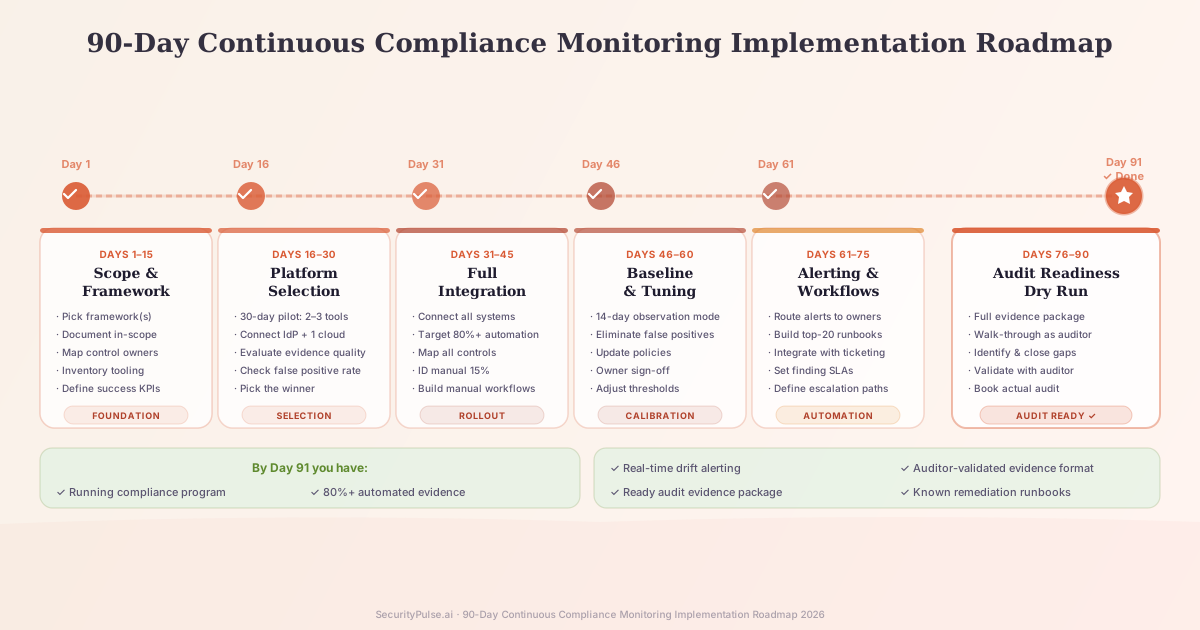
A 90-day implementation roadmap that's worked across 40+ SMB and mid-market deployments.
Scope and framework selection
Pick the framework(s). Document in-scope systems, data stores, and cloud accounts. Map responsible owners for each control category. Inventory existing tooling (SIEM, EDR, cloud posture, identity) that you'll connect to the monitoring platform.
Platform selection and deployment
Run a 30-day pilot with two or three of the shortlisted tools. Connect at minimum your identity provider, one cloud account, and your endpoint platform to each. Evaluate evidence quality, false positive rate, and time-to-first-finding. Pick the winner.
Full integration rollout
Connect the remaining systems. Target 80%+ of your control evidence coming from automated sources by the end of this phase. Map every framework control to specific automated or manual evidence. Identify the 10-15% of controls that will always require manual attestation and build workflows for them.
Baseline and tuning
Run the platform for 14 days in observation mode. Review all findings. Tune thresholds to eliminate false positives. Update policies to reflect the actual operating environment. Get control owners to acknowledge their controls and the evidence the platform captures.
Alerting and remediation workflows
Configure alert routing to the right owners. Build runbooks for the top 20 likely findings. Integrate with your ticketing system so findings create tickets with SLAs. Define escalation paths.
Audit readiness dry run
Generate a full evidence package for your chosen framework. Walk through it as an auditor would. Identify gaps. Close them. Book the actual audit.
By day 91 you have a running program, automated evidence for 80%+ of controls, real alerting on drift, and a ready audit package.
Continuous compliance monitoring for GDPR and HIPAA
These two frameworks come up in nearly every SMB compliance conversation and have specific monitoring patterns that differ from SOC 2 or ISO 27001.
GDPR continuous monitoring implementation
GDPR doesn't prescribe monitoring cadence explicitly. Article 32 requires "ongoing confidentiality, integrity, availability, and resilience of processing systems" plus "regularly testing, assessing, and evaluating the effectiveness of technical and organisational measures." In practice, this means:
- Data flow monitoring. Where is personal data moving, across which systems, across which borders. DLP and CASB platforms feed this.
- Consent management monitoring. Are consent records current for each processing purpose. Consent platforms (OneTrust, Osano) feed this.
- Data subject request SLA tracking. Right to access, erasure, portability requests must be completed within 30 days. Monitoring tracks open requests against SLA.
- Breach notification readiness. Detection capability must identify reportable breaches within 72 hours of discovery.
- Vendor data processing agreements. DPAs must be in place with every processor handling personal data; expiration and updates need monitoring.
- Privacy Impact Assessment refresh. High-risk processing activities need periodic reassessment.
A monitoring program for GDPR primarily integrates with identity, DLP, consent management, and vendor management systems.
HIPAA continuous monitoring implementation
HIPAA Security Rule monitoring centres on ePHI access, systems that store or transmit ePHI, and the administrative, physical, and technical safeguards around them.
- ePHI access logging. Every access to systems containing ePHI must be logged and regularly reviewed per §164.308(a)(1)(ii)(D) and §164.312(b).
- Workforce access reviews. Quarterly access reviews for ePHI, with automatic flagging of privileged access and role changes.
- Business Associate Agreement tracking. BAAs must be in place with every third party handling ePHI; expiration monitoring prevents gaps.
- Encryption status monitoring. ePHI at rest and in transit must be encrypted; continuous verification across all systems.
- Workforce training completion. Annual HIPAA training with continuous completion tracking.
- Contingency plan testing. Backup verification, disaster recovery testing, incident response drills with documented outcomes.
- Risk analysis updates. §164.308(a)(1)(ii)(A) requires ongoing risk analysis. Platform should track when risks were last assessed.
For a practitioner-grade healthcare cybersecurity and HIPAA compliance approach, we run continuous monitoring aligned to the Security Rule across all nine HIPAA-designated categories.
The role of continuous monitoring in zero trust compliance
Zero trust architecture is built on the principle of "never trust, always verify." Continuous compliance monitoring is the operational implementation of that principle.
NIST SP 800-207 (Zero Trust Architecture) explicitly calls out continuous monitoring as one of the seven tenets: "The enterprise monitors and measures the integrity and security posture of all owned and associated assets." This means every device, user, and workload needs continuous posture verification before access decisions are made, not just at initial authentication.
In practice, continuous monitoring in a zero trust context requires tighter feedback loops than traditional compliance monitoring:
- Device posture checks at every access request, not just at device enrollment. EDR agents feed real-time device posture into access policy engines.
- Identity risk scoring continuously updated based on authentication patterns, device trust, network location, and behavioral signals.
- Workload identity verification for service-to-service communication, with continuous validation of service principals and mTLS certificates.
- Micro-segmentation policy drift detection. Zero trust networks rely on granular segmentation; any lateral movement attempt or policy drift needs immediate detection.
- Session-level monitoring rather than session-start monitoring. Long-lived sessions need continuous evaluation, and privilege escalation or anomalous behaviour triggers re-authentication.
Frameworks that require both zero trust architecture and continuous monitoring (CMMC 2.0, FedRAMP High, DoD Zero Trust Reference Architecture) are the strictest implementations. If you meet these requirements, you satisfy most other monitoring requirements by default.
Build vs. buy: a decision framework
Some security teams, particularly at larger organisations with strong engineering cultures, consider building this in-house on top of their SIEM. Here's the honest tradeoff.
When build makes sense
- You have more than 500 engineering staff with mature internal platform teams
- Your compliance profile is unusual (research, classified, nation-state adversary models)
- You already have 80%+ of the data in a well-instrumented SIEM or data lake
- You have dedicated GRC engineers who can maintain the mapping layer long-term
- Your budget supports 3-5 FTE dedicated to the program
When buy makes sense
- You're pursuing standard frameworks (SOC 2, ISO 27001, HIPAA, PCI DSS, NIST CSF)
- Your team is under 500 engineers or your security team is under 10
- Time-to-audit matters more than platform optimisation
- You want framework updates handled by the vendor
- You want auditor familiarity with your evidence format
For SMBs and mid-market companies, buy almost always wins. The total cost of ownership for a built program is typically $400k–$1.2M per year once you count engineering time, platform hosting, ongoing framework updates, and auditor education. A commercial tool costs $12k–$50k per year for the same SMB.
For MSSPs running compliance across many client organisations, the calculus shifts. Off-the-shelf tools are built for single-tenant SaaS customers, not for service providers managing 50 SMB clients. This is exactly the gap SecurityPulse AI addresses with a multi-tenant autonomous compliance monitoring architecture. Learn more at how it works.
Common continuous compliance monitoring mistakes
Eight patterns we see repeatedly in SMB and mid-market programs.
The shift to autonomous compliance monitoring
The next evolution of continuous monitoring, already well underway in 2026, is autonomous monitoring. Where current platforms ingest signals, map controls, evaluate, and alert, autonomous platforms also investigate findings, triage by risk, take remediation action, and close the loop with evidence of resolution — all without human intervention on routine items.
The AI capability that unlocks this is agentic reasoning over security and compliance telemetry. An agent that sees "user X logged in from unusual geography and accessed ePHI at 3am" can pull the user's HR status, check VPN logs, check the data sensitivity of accessed records, check the user's historical patterns, correlate with recent travel if that data is available, and make a risk determination — all in seconds. This pattern is what we call Autonomous Extended Security Operations (AXSO).
For MSSPs and vCISO firms running compliance monitoring across dozens of client organisations, autonomous monitoring is the difference between a viable service business and an unscalable one. Manually running 30 SMB compliance programs on traditional GRC tools consumes 3-5 FTE. Running them with autonomous agents consumes a fraction of one.
This is what we built SecurityPulse AI to do. If you run compliance for multiple organisations or want to run your own compliance program with dramatically lower overhead, book a free consultation call.
Making continuous monitoring real
Continuous compliance monitoring stopped being aspirational in 2026. PCI DSS v4.0 made it mandatory. NIST and FedRAMP have required it for years. Every major framework expects it in practice even when not named explicitly. Enterprise buyers are contractually requiring it from their vendors. The question for security leaders is no longer whether to implement continuous monitoring — it's how fast and with which platform.
For SMBs running their first compliance program, pick a GRC-first platform (Vanta, Drata, Secureframe, Sprinto, or Scrut) matched to your framework mix. For mid-market companies scaling multi-framework programs, evaluate the enterprise tier (Hyperproof, AuditBoard, Anecdotes). For MSSPs and vCISO firms running compliance across many client organisations, evaluate multi-tenant autonomous platforms including SecurityPulse AI.
Whatever you pick, start with a 90-day implementation roadmap, connect your 10 highest-value systems first, tune alerts in observation mode before routing to humans, and validate evidence format with your auditor before signing anything.
If you're running compliance for multiple organisations or want to understand how autonomous compliance monitoring changes the economics of your program, book a free consultation call or explore our compliance readiness solution. Start with the broader context in our cybersecurity compliance guide if you haven't already.
Further reading
- Autopilot — the AI SOC powering continuous monitoring — the platform that ingests, correlates, and triages compliance signals 24/7.
- Cybersecurity Compliance: The Complete 2026 Guide — 12 frameworks compared, real audit costs, penalty data, and how MSSPs run continuous compliance for SMBs.
- Compliance Readiness Solution — how SecurityPulse runs continuous monitoring across SOC 2, ISO 27001, HIPAA, PCI DSS, and NIST CSF.
- SOC 2 framework — the most-requested SaaS attestation, automated end to end.
- ISO 27001 framework — the global ISMS standard mapped to your existing controls.
- PDPA Compliance Checklist for Singapore SMBs — practical data protection compliance for Singapore businesses.
- Cyber Trust Mark: Complete Guide for Singapore Businesses — CSA's advanced cybersecurity certification mapped to ISO 27001.
- CEM vs CTM in Singapore — choose the right CSA certification path.
- Cybersecurity Strategy for Small Businesses — the 10-step program that makes continuous compliance achievable without a large team.