What is the NIST Cybersecurity Framework?
The NIST Cybersecurity Framework — usually written as NIST CSF — is a voluntary framework published by the US National Institute of Standards and Technology. It gives every organisation a common language to:
- Describe its current cybersecurity posture.
- Describe its target cybersecurity posture.
- Identify and prioritise the gap between the two.
- Communicate cyber risk to leadership, customers, regulators, and insurers in a way everyone understands.
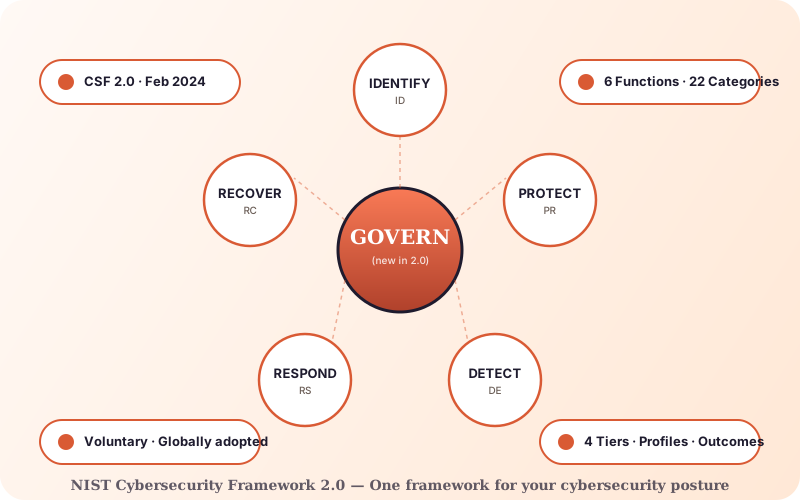
CSF was first released in 2014 for US critical infrastructure. CSF 2.0, published on February 26, 2024, is the current version — and the first explicitly designed for any organisation, in any sector, in any country. That is why it has become the default cybersecurity reference framework worldwide.
What's new in NIST Cybersecurity Framework 2.0
CSF 2.0 is the biggest update in a decade. Four changes matter most:
- The new GOVERN function. Cybersecurity governance, supply chain, and enterprise risk management are no longer buried inside Identify — they are a peer function alongside Identify, Protect, Detect, Respond, and Recover. This change reflects how CISO and board accountability has matured since 2018.
- Universal scope. The 2014 version targeted US critical infrastructure. CSF 2.0 explicitly applies to organisations of all sizes, sectors, and geographies — startups, SMBs, multinationals, non-profits, public sector.
- Implementation guidance built in. NIST now publishes Quick Start Guides for small business, enterprise risk management, and supply chain. Community Profiles tailor the framework to specific sectors (healthcare, manufacturing, election infrastructure, etc.).
- Modern threat coverage. Strengthened content on third-party / software supply chain risk, secure software development, identity-driven attacks, and emerging AI considerations.
Who needs NIST CSF 2.0?
Technically nobody is forced to adopt CSF — it is voluntary. In practice, you almost certainly should if any of these apply:
- You are a US business looking for a single framework to organise your cybersecurity programme.
- You sell into US enterprises who increasingly request CSF alignment in security questionnaires.
- You are pursuing cyber insurance — most US underwriters now reference CSF in their applications.
- You operate in regulated sectors (financial services, healthcare, energy, public sector) where regulators benchmark against CSF.
- You want a plain-English board narrative for your cyber posture and risk decisions.
- You are starting from scratch and need a roadmap instead of a wall of controls.
If you are also pursuing certifiable standards like ISO 27001 or SOC 2, CSF still earns its place — most teams use it as the strategic narrative layer above their certified ISMS.
The six core functions
CSF 2.0 organises cybersecurity into six functions. Each function holds categories, and each category holds subcategories — these are the actual outcomes you implement and measure.
Govern
Establish, communicate, and monitor the cyber risk strategy, expectations, and policy. Includes context, risk strategy, roles & responsibilities, policy, oversight, and supply chain.
Identify
Understand the assets that enable the business, the people who use them, the suppliers behind them, and the risks they face.
Protect
Use safeguards to limit or contain the impact of a cyber event — identity & access, awareness & training, data security, platform security, technology infrastructure resilience.
Detect
Find and analyse possible cybersecurity attacks and compromises. Continuous monitoring and adverse event analysis.
Respond
Take action on a detected incident — incident management, analysis, response reporting and communication, mitigation.
Recover
Restore assets and operations affected by a cybersecurity incident, and learn from it.
The four implementation tiers
Tiers describe how rigorous and adaptive your cyber risk practices are. They are not maturity levels you must reach — they are a way to express how much rigor your risk profile justifies. A 15-person SaaS startup at Tier 2 may be perfectly appropriate; a global bank at Tier 2 is in trouble.
| Tier | Name | What it looks like |
|---|---|---|
| 1 | Partial | Ad-hoc, reactive practices. Limited awareness of cyber risk. No organisation-wide approach. |
| 2 | Risk Informed | Management-approved practices, but inconsistent across the organisation. Limited external sharing. |
| 3 | Repeatable | Organisation-wide policies, regularly updated. Risk-informed decisions consistent with strategy. Active threat sharing. |
| 4 | Adaptive | Continuous improvement using lessons learned and predictive indicators. Cyber risk fully integrated with enterprise risk. |
A practical view: most US SMBs land between Tier 1 and Tier 2 today. Cyber-insurance and enterprise-procurement pressure is moving the floor to Tier 3 fast. We unpack this in our Cybersecurity Maturity Model guide.
Profiles — and the "one framework, one cybersecurity posture" idea
A Profile is your selected set of CSF outcomes — what is in scope for your organisation, today and tomorrow.
- Current Profile: what you are doing today across all 106 outcomes.
- Target Profile: what you intend to be doing, given your risk appetite and obligations.
- Community Profile: a sector-specific starter profile NIST publishes (e.g. healthcare, manufacturing, election infrastructure).
This is where CSF earns its reputation as the "one framework for your cybersecurity posture". Instead of juggling SOC 2, ISO, HIPAA, PCI, and a stack of state laws as separate spreadsheets, you map them all into a single CSF Target Profile. One language. One scorecard. One narrative for the board.
90-day implementation roadmap
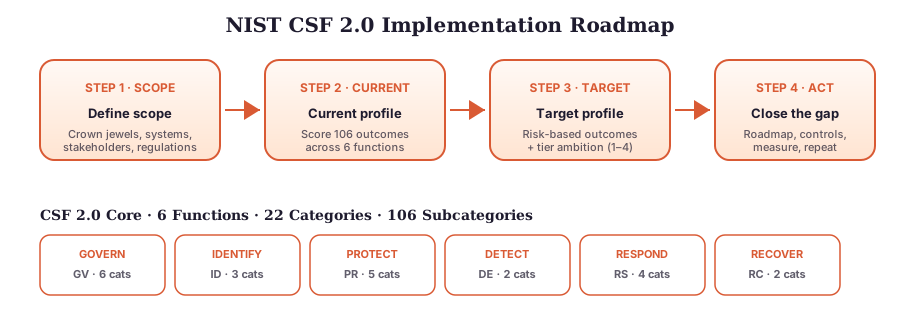
Days 0–14 Scope
- List crown-jewel data, systems, and business processes.
- Identify stakeholders (business, legal, HR, IT, vendors, regulators).
- List the regulations and contracts that already constrain you (HIPAA, PCI, state privacy, SOC 2, etc.).
Days 15–45 Current profile
- Score every one of the 106 subcategories: Not in place / Partial / Largely / Fully.
- Capture the evidence behind each score — log sources, screenshots, policy references.
- Estimate your current tier per function.
Days 30–60 Target profile + gap analysis
- Set the target outcome level for each subcategory based on risk and obligations.
- Pick a target tier per function.
- Generate the gap list and prioritise by risk reduction per dollar.
Days 45–90 Execute the first sprint
- Address the top 10–20 gaps. Most are policy, identity, monitoring, backup, or vendor risk.
- Stand up evidence collection so the next assessment is automated, not manual.
- Brief the board on the new posture and the rolling roadmap.
After day 90, CSF becomes a continuous programme: re-score quarterly, refresh the target annually, treat new threats as inputs to the gap list.
Where to get the official NIST Cybersecurity Framework PDF
NIST publishes the entire CSF 2.0 specification — including the core (functions, categories, subcategories), informative references, and tier definitions — for free at nist.gov/cyberframework. You can download:
- The CSF 2.0 PDF (NIST CSWP 29).
- The Core in JSON and Excel for tooling.
- Quick Start Guides — Small Business, Enterprise Risk Management, Supply Chain Risk Management, Community Profiles.
- The official NIST CSF 2.0 Reference Tool, which lets you build and export custom profiles.
NIST does not charge for any of it. If a vendor is selling you "the NIST Cybersecurity Framework PDF" — they are selling you something NIST already gives you for free.
NIST CSF 2.0 vs ISO 27001 vs CMMC
| NIST CSF 2.0 | ISO 27001:2022 | CMMC 2.0 | |
|---|---|---|---|
| Type | Voluntary framework | Certifiable international standard | Mandatory US DoD certification |
| Output | Self/third-party assessment, profile | 3-year certificate | Level 1/2/3 certification |
| Best for | Strategic posture & board narrative | Global enterprise sales | US defence supply chain |
| Cost (small org) | $0–$25K assessment | $30K–$80K total | $15K–$120K total |
| Time to implement | 3–6 months | 9–12 months | 3–12 months |
| Overlap | ~70% of CSF outcomes map to ISO 27001 controls; CSF maps directly to NIST 800-53 / 800-171 used by CMMC. | ||
How Security Pulse helps with NIST CSF 2.0
RunWay — Build the profile
- Scope, stakeholder map, regulatory inventory.
- Current profile scoring across all 106 outcomes.
- Risk-based target profile and tier selection.
- Gap analysis and prioritised 90-day roadmap.
- Board-ready posture report on day 90.
Autopilot — Run the functions
- Govern: policy library, supply-chain risk, evidence vault, quarterly board reports.
- Identify: live asset and supplier inventory, risk register.
- Protect: identity, MFA, endpoint, email, data security.
- Detect: 24/7 monitoring, anomaly & insider-threat analytics.
- Respond & Recover: automated triage, containment runbooks, backup verification.
Pair this with our continuous compliance monitoring approach and your CSF profile updates itself — instead of being rebuilt every audit cycle.