If you run a clinic, a specialist practice, a diagnostic lab, an aesthetic chain, or a telemedicine startup in Singapore, the next 18 months are going to ask harder questions of your business than the last 18 years did. The Health Information Bill passed Parliament on 12 January 2026 and takes effect in early 2027. The PDPA still applies on top of it. NRIC numbers can no longer be used as authentication credentials. NEHR participation becomes mandatory for licensed providers. And patient health data is now in the same legal risk category as financial data, with PDPC fines that can hit SGD 1 million or 10% of your annual Singapore turnover, whichever is higher.
If you read that paragraph and felt your stomach drop a little, book a free 30-minute consultation with our team at SecurityPulse. We will walk you through exactly where you stand, what to fix first, and what the next 9 months should look like for your clinic. No deck, no sales pitch, just an honest map of where the gaps are. The rest of this guide is what we cover in that call anyway, so you can read it first if you prefer.
This is written for the founder, clinic owner, practice manager, or operations head of a Singapore healthcare SMB. It assumes you have between 5 and 150 staff, no in-house security team, and patient data sitting across an EMR, a billing system, Microsoft 365 or Google Workspace, a website, and a few SaaS tools. It assumes you are starting from scratch.
The 2026 to 2027 Regulatory Reality
Three pieces of law now stack on top of each other for any healthcare provider in Singapore. You cannot satisfy one and ignore the others.
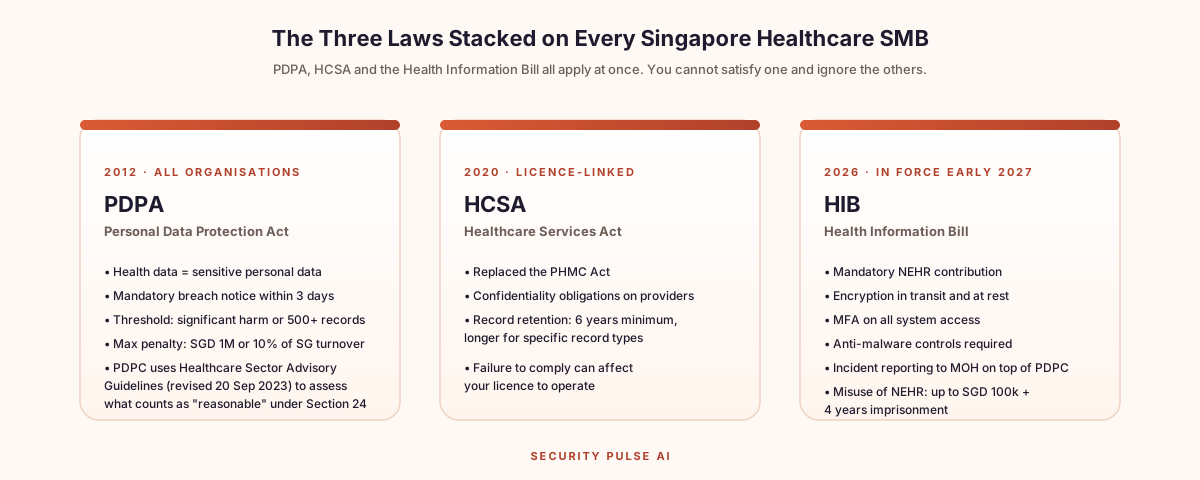
The Personal Data Protection Act (PDPA), 2012. Applies to all organisations. Healthcare data is treated as sensitive personal data, which means the PDPC expects a higher standard of protection. Mandatory breach notification kicks in within 3 calendar days of assessing that a breach is likely to cause significant harm or affects 500 or more individuals. The maximum penalty is SGD 1 million or 10% of your annual turnover in Singapore, whichever is higher. Our complete 2026 PDPA guide walks through every obligation in detail.
The Healthcare Services Act (HCSA), 2020. Replaced the Private Hospitals and Medical Clinics Act. Imposes confidentiality and record retention requirements (typically 6 years minimum, longer for specific record types). Failure to comply can affect your licence to operate.
The Health Information Bill (HIB), 2026. Passed in January 2026, takes effect from early 2027. Mandates that all licensed healthcare providers contribute defined patient data to the National Electronic Health Record (NEHR) system. Patient consent is not required for NEHR contribution. The bill imposes specific cybersecurity obligations including encryption in transit and at rest, MFA for all system access, anti-malware controls, and incident reporting to the Minister for Health on top of existing PDPC reporting obligations. Accessing the NEHR for unauthorised purposes (for example, for insurance) carries fines of up to SGD 100,000 and imprisonment up to 4 years.
Two more changes worth noting:
The NRIC authentication ban. A joint advisory from the PDPC and CSA in June 2025 made it clear that NRIC numbers must not be used as authentication credentials. Enforcement intensifies from 1 January 2027. If your clinic still uses NRIC as a default password, as a security question answer, or combined with a date of birth as identity verification, you are already exposed to a Section 24 PDPA breach finding.
Healthcare Sector Advisory Guidelines. The PDPC and MOH revised these on 20 September 2023. They are not legally binding but the PDPC uses them to assess whether your security arrangements were "reasonable" under Section 24. In enforcement cases, organisations that ignored the guidelines have been fined more aggressively than those that visibly followed them.
The single most important thing to internalise: the PDPC has stated that handling large volumes of sensitive medical data without proportional safeguards is an aggravating factor in penalty calculations. You are held to a higher standard because you treat patients.
What Data You Actually Have (And Why It Is Worse Than You Think)
Most clinic owners underestimate their data footprint by a factor of three. A typical Singapore healthcare SMB holds:
Patient clinical data. Medical history, diagnoses, prescriptions, lab results, imaging, allergies, mental health notes, sexual health records, fertility records, oncology records. Under HIB, certain categories will be classified as Sensitive Health Information with restricted access even within NEHR.
Patient identity data. Full name, NRIC or FIN, date of birth, residential address, contact numbers, emergency contact details, employer information, next of kin.
Patient financial data. Insurance policy numbers, MediSave and MediShield details, credit card data (often stored or referenced through your payment gateway), outstanding balances, payment history.
Employee data. NRIC, salary information, CPF details, bank account numbers, performance records, medical leave records (which is itself health data about your staff).
Operational data that contains patient information. Appointment schedules, no-show records, billing reports, insurance claim submissions, referral letters to specialists, Telegram and WhatsApp messages with patients (extremely common and almost always non-compliant), email backups, SMS reminder logs.
Vendor and partner data. Contracts with insurers, panel doctor agreements, telemedicine platform credentials, lab partner data feeds, software vendor access keys.
The non-obvious risk concentration is in unstructured data. The Word document on your practice manager's laptop with a patient list. The spreadsheet of high-value clients shared over email. The clinical photos on a doctor's personal phone. The Telegram group with patient names and chief complaints. None of this is in your EMR, but all of it is your liability.
The Threats Specifically Targeting Singapore Healthcare SMBs
Healthcare is the most-targeted sector globally because the data has long resale value (medical records are evergreen, unlike credit card numbers) and because clinics tend to pay ransoms quickly to restore patient care. Specific patterns we see in Singapore SMBs:
Ransomware via clinic management software. Older EMR and PMS deployments with unpatched servers or weak admin passwords. Once attackers are in, they encrypt the database, you cannot run appointments, and you have 4 to 72 hours of decision pressure.
Phishing targeting front-desk staff. Front desk roles have high turnover, get hundreds of patient emails a day, and have access to scheduling systems that often contain NRICs and contact details. A successful credential theft here often leads to mailbox compromise and data exfiltration.
EMR vendor compromise. Your data is only as secure as your software vendor's security. The People Central case in January 2026 (SGD 17,500 fine, 95,000 records exfiltrated) and Singapore Data Hub case in April 2025 (SGD 17,500 fine, 689,000 records) both involved SaaS providers that the underlying clients trusted to handle their data. The Fullerton Healthcare breach in 2022 led to a SGD 58,000 fine and remains one of the clearest precedents for healthcare SMB liability.
Insider mistakes. Doctors emailing patient records to their personal Gmail to work from home. Staff sharing logins because the EMR has too few licences. USB drives moving between clinic computers and home laptops. Old employees retaining access for months after leaving.
Telemedicine and remote consultation risks. Video consultation platforms that are not HIPAA-grade or PDPA-aligned. Recordings stored on consumer cloud accounts. Cross-border consultations with overseas specialists that trigger PDPA transfer obligations.
Insurance and HR data exposure. Group insurance schemes that transmit employee health data to corporate clients without proper Data Processing Agreements. Bulk claim submissions over unencrypted email.
Deepfake and voice-clone wire fraud. Increasingly common in 2026. Clinic finance staff get a voice note from someone sounding like the CEO authorising a vendor payment. The voice was cloned from a YouTube interview the founder gave 18 months ago.
The 9-Month Roadmap From Zero to Compliant
Realistic timeline. Aggressive but achievable. Assumes you have a practice manager or ops lead who can dedicate 10 to 15 hours a week to this and a budget commitment from the founder.
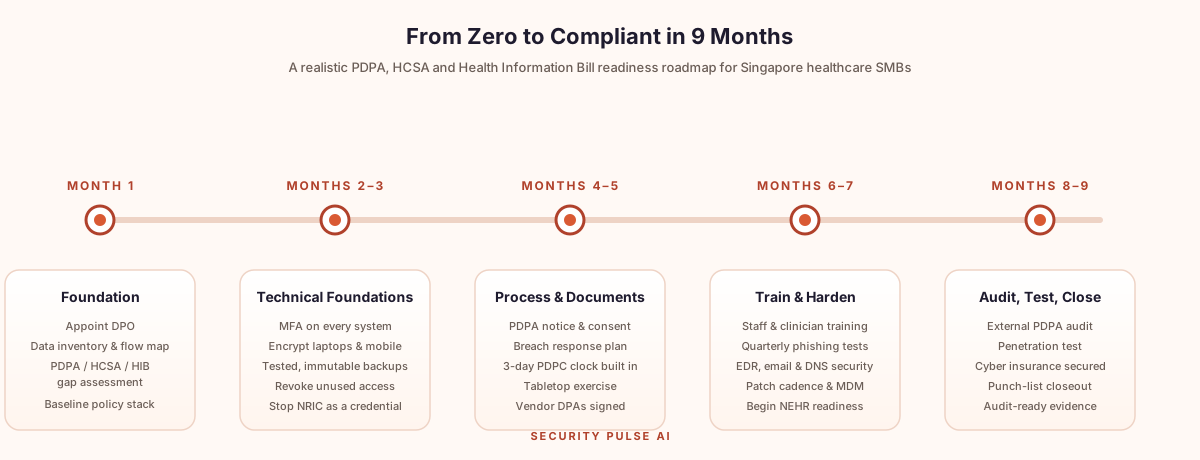
Month 1: Foundation and Data Mapping
Appoint a Data Protection Officer (DPO). Mandatory under PDPA. For a clinic of fewer than 30 staff, this is usually outsourced to a DPO-as-a-service provider for SGD 1,500 to 4,000 per month. The DPO must be a real person with their contact details registered with PDPC and published on your website.
Conduct a full data inventory and data flow map. Where does patient data live, who touches it, where does it go, how long is it kept. Plan for 3 to 5 working days of intensive interviews and shadowing across reception, clinical staff, billing, IT, and management.
Run a baseline gap assessment against PDPA, HCSA, and the HIB readiness criteria. The output is a prioritised list of 30 to 80 findings. Most clinics we assess have between 45 and 70 in month one.
Stand up a basic policy stack: Data Protection Policy, Acceptable Use Policy, Incident Response Policy, Retention Policy, Vendor Management Policy. These are templates, not custom documents at this stage.
Month 2 to 3: Technical Foundations
Roll out MFA on every system that touches patient or employee data. Microsoft 365 or Google Workspace, your EMR, your billing system, your remote access, your VPN, your cloud storage. No exceptions. SMS-based MFA is acceptable as a starting point but app-based MFA (Microsoft Authenticator, Google Authenticator, or hardware keys for high-risk roles) is the target.
Encrypt laptops and mobile devices using BitLocker, FileVault, or your EMR vendor's mobile device management. Verify backups are working, encrypted, tested for restoration, and stored offline or in immutable storage. Most ransomware victims discover their backups failed only when they need them.
Review and revoke unused access. Every active directory account, every SaaS account, every shared inbox. Most healthcare SMBs find 15 to 30% of their accounts belong to ex-staff, contractors who finished engagements 2 years ago, or shared logins that no individual owns.
Stop using NRIC as an authentication credential anywhere. Patient portal passwords, internal logins, security questions, default passwords, anything. If your EMR vendor is still doing this, raise it with them in writing.
Month 4 to 5: Documentation and Process
Build out the full PDPA-compliant policy and procedure stack. This includes the Data Protection Notice (the public-facing one your patients see), Consent forms for clinical and non-clinical uses, Data Breach Response Plan (with the 3-day PDPC notification clock built in), Subject Access Request handling procedure, Data Retention Schedule mapped to HCSA's 6-year minimum and longer requirements for specific record types.
Implement an incident response runbook. Who calls who, what gets isolated, what gets logged, when does the DPO escalate to PDPC. Run a tabletop exercise simulating a phishing-led ransomware incident. Time how long it takes you to detect, contain, and notify. Most first-time tabletops reveal that the team has no idea who has authority to take systems offline or pay a ransom.
Vendor risk assessments. Every third party that touches patient data signs a Data Processing Agreement and provides evidence of their own security controls. EMR vendor, billing software, lab integration, telemedicine platform, marketing tools that send patient SMS reminders, your IT support company.
Month 6 to 7: Training, Hardening, NEHR Readiness
Deliver mandatory PDPA and cybersecurity awareness training for every staff member, including doctors and contractors. Annual refresh. Phishing simulation campaigns at least quarterly. Track and remediate repeat clickers. Healthcare-specific scenarios (fake patient enquiry emails, fake insurance claim portals, fake MOH circulars) work better than generic content.
Harden your endpoints. Endpoint detection and response (EDR) on every device. Email security (anti-phishing, attachment sandboxing) on Microsoft 365 or Google Workspace. DNS filtering. Patch management process with monthly cadence and emergency patch protocol for critical vulnerabilities.
Begin NEHR readiness. Even though HIB takes effect in early 2027, MOH will issue guidance materials from Q2 2026 and dedicated support channels. Map your data contributions, identify which categories qualify as Sensitive Health Information, ensure your EMR vendor has confirmed NEHR connectivity timelines.
Month 8 to 9: Audit, Test, Close Gaps
External PDPA compliance audit. SGD 8,000 to 25,000 depending on the size of your practice. The audit produces a formal report you can show to insurers, corporate clients, and regulators.
Penetration test. SGD 8,000 to 20,000 for a typical clinic environment. The pentest reveals real vulnerabilities, not theoretical ones. Expect 10 to 30 findings, most of them medium severity, a few critical that need immediate fixing.
Cyber insurance procurement. SGD 5,000 to 25,000 annual premium for a typical Singapore healthcare SMB. Insurers will ask for proof of MFA, backups, incident response plan, and recent training. Without this evidence, premiums are 2 to 3x higher or coverage is declined.
Close gaps. The audit and pentest produce a clean punch list. Work through it methodically.
By the end of month 9, you have a defensible compliance posture for PDPA, are positioned for HIB when it takes effect, and have a security baseline that protects the business from the most common attack patterns.
The Real Cost (In SGD)
We are putting realistic numbers here because most Singapore healthcare SMBs underbudget by half and then abandon the project at month 4.
Year 1 setup and ongoing combined. SGD 60,000 to 140,000 for a 20 to 50 person clinic. Higher end if you want strong consulting support. Lower end if you have a capable practice manager and use technology to absorb most of the operational load.
Specific line items (typical SMB ranges):
- Outsourced DPO service: SGD 18,000 to 48,000 per year
- vCISO retainer or fractional security lead: SGD 36,000 to 96,000 per year (most clinics under 30 staff defer this until year 2)
- PDPA gap assessment and policy development: SGD 8,000 to 20,000 one-time
- Security tools (MFA, EDR, email security, DNS filter, MDM): SGD 12,000 to 36,000 per year
- Phishing simulation and security awareness training: SGD 3,000 to 12,000 per year
- Annual compliance audit: SGD 8,000 to 25,000
- Annual penetration test: SGD 8,000 to 20,000
- Cyber insurance premium: SGD 5,000 to 25,000
- Incident response retainer: SGD 18,000 to 60,000 per year (often deferred but very valuable)
Year 2 and beyond. SGD 40,000 to 90,000 ongoing if you have done the year 1 foundation properly.
The big swing factor is whether you build this on consultants and point tools, or whether you consolidate onto a platform. Consultants and point tools usually mean SGD 100,000+ in year 1 and similar ongoing because you are paying for human time at every step. Platforms can compress this to SGD 50,000 to 70,000 because the technology absorbs the repeatable work. See our guide to continuous compliance monitoring for how this works in practice.
The 12 Controls You Cannot Skip
These are the non-negotiables. If your audit finds gaps in any of these, the PDPC will treat it as evidence of unreasonable security arrangements.
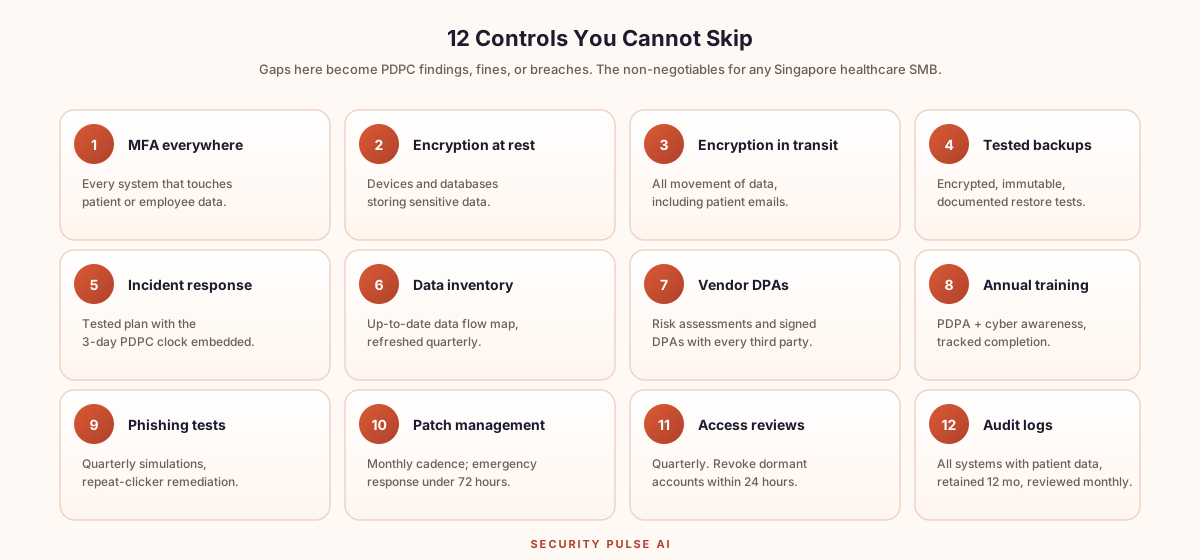
- Multi-factor authentication on every system that touches patient or employee data
- Encryption at rest on all devices and databases that store sensitive data
- Encryption in transit for all data movement, including emails containing patient identifiers
- Tested, encrypted, offline or immutable backups with documented restore evidence
- Documented and tested incident response plan with the 3-day PDPC notification clock embedded
- Up-to-date data inventory and data flow map maintained quarterly
- Vendor risk assessments and signed Data Processing Agreements with every third party
- Annual PDPA and cybersecurity awareness training with completion tracking
- Quarterly phishing simulation with remediation for repeat clickers
- Patch management with monthly cadence and emergency response under 72 hours for critical CVEs
- Access reviews quarterly with prompt revocation of dormant accounts
- Audit logs on all systems holding patient data, retained for at least 1 year and reviewed monthly
If you cannot truthfully tick all 12, you have a gap that will become a finding, a fine, or a breach.
Common Mistakes That Lead to PDPC Findings
These are the patterns we see most often in Singapore healthcare SMBs that get fined or investigated:
Storing patient data on personal Gmail accounts or personal cloud drives because the practice email is "too slow." This single mistake produces more breach reports than any other.
Sharing logins between front desk staff because the EMR licence count is too low. Every audit log entry shows a single user, which makes accountability impossible after a breach.
Telegram and WhatsApp groups with patient information for clinical handover. Convenient, completely non-compliant, and almost never deleted.
Not retiring access for staff who have left. Three to six months after departure, ex-employees often still have working VPN, EMR, and email access.
Vendor agreements without data processing terms. The vendor has your patient data, you have no contractual basis to hold them accountable for a breach, and the PDPC will treat that as your failure.
Backups that have never been tested. Discovered the hard way during a ransomware incident, when you find the backup files are encrypted by the same ransomware or the restore process does not actually work.
DPO appointed in name only. Practice manager listed as DPO with no time, training, or authority to actually do the role. PDPC investigations consistently reveal this pattern.
Marketing using patient data without consent. SMS reminder systems repurposed for promotional outreach. Clinical lists exported for festive greetings. Each of these is a separate PDPA violation.
What "Good" Looks Like at Month 9
A clinic that has done this properly looks like the following:
Every employee logs in to every system using their own credentials with MFA. No shared logins anywhere. Access is granted by role, reviewed quarterly, revoked within 24 hours of departure.
Patient data does not leave the EMR or the approved cloud workspace. Email, Telegram, WhatsApp, and personal devices are not used for clinical communication. Where patient communication is needed, it goes through a secure messaging tool inside your platform.
The DPO has a real name, a real role, real authority, and a documented quarterly cadence of work that includes data inventory updates, vendor reviews, training completion checks, and audit log reviews.
If a breach happens, the team knows in the first 30 minutes who calls who, who isolates what, who notifies the PDPC, who notifies patients, who handles media. The 3-day notification clock is not a panic moment.
When a corporate client, an insurer, or a panel network asks for proof of security and PDPA compliance, the answer is a current audit report, a SOC 2 Type 2 attestation if you have gone that far, current pentest results, and a one-page security overview. Procurement decisions stop being a slow disadvantage and start being a competitive advantage.
When HIB takes effect in early 2027, NEHR contribution is configured, Sensitive Health Information categories are correctly tagged, the additional cybersecurity obligations are already in place, and the MOH reporting line is built into your incident response plan.
That is what 9 months of disciplined work produces.
Why Most Clinics Try This and Fail
The standard approach is to hire a PDPA consultant for SGD 30,000, get a stack of policies, then realise nothing has actually changed in your day-to-day operations. The consultant leaves, the policies sit in a SharePoint folder, and 18 months later when an incident hits, the response is the same chaos as before.
The reason this fails is structural. Compliance is a documentation exercise that lives on paper. Security is an operational reality that lives in your systems and your people. You can have perfect policies and zero security, and the PDPC will still find against you.
The other failure pattern is buying 8 to 12 separate security tools (an EDR, a DNS filter, an email security gateway, a phishing trainer, a backup product, a vulnerability scanner, an MDM, an IAM, and so on), spending SGD 40,000 to 80,000 a year, and ending up with an alert volume your team cannot triage. The tools are technically deployed but operationally useless.
A clinic with 30 staff cannot run a 12-tool security stack. A clinic with 100 staff cannot either. Even a 500-bed hospital struggles with this and they have a SOC team. You need consolidation, not accumulation.
How SecurityPulse Changes the Math
This is the part where we tell you what we do, because we built SecurityPulse for exactly this problem.
SecurityPulse is a complete cybersecurity platform for healthcare SMBs that do not have a dedicated security team. We replace the 12-tool stack and the SGD 60,000 a year of consultants with a single platform that does the work, plus a small expert team that runs it for you.
What this means in practice for a Singapore healthcare SMB:
Day 1 deployment. We deploy the technical foundations (MFA, EDR, email security, DNS filtering, MDM, audit logging, backup validation) across your environment in a single day with RunWay. Not a 6-week project. Not a 3-month rollout. One day.
Autopilot AI runs the operations. The platform monitors your environment 24/7, detects threats, investigates them, and responds to them automatically. Phishing emails get quarantined. Suspicious logins get blocked. Ransomware behaviour gets contained before it spreads. Autopilot replaces the SOC team you would otherwise need to hire (and could not afford anyway).
PDPA and HIB compliance built in. We map every control to PDPA, HCSA, and HIB requirements. The platform produces audit-ready evidence on demand. When the PDPC asks, when an insurer asks, when a corporate client asks, you click a button and download the report.
Healthcare-specific configuration. EMR integration, NEHR readiness for early 2027, NRIC handling that meets the new authentication ban, telemedicine platform security, vendor DPA management. We have built this for clinics, not for generic SMBs. See our cybersecurity for healthcare page for more.
Singapore-priced and Singapore-staffed. Our pricing is built for Singapore healthcare SMBs, not retrofitted from a US enterprise product. Our security operations team understands PDPC enforcement patterns, MOH guidance, and the realities of running a clinic in Singapore.
The honest comparison: a 30-staff clinic doing the conventional approach spends SGD 80,000 to 140,000 in year 1 and ends up with paper compliance and operational chaos. The same clinic on SecurityPulse spends SGD 30,000 to 50,000 in year 1 and ends up with real security, real compliance, and real audit-ready evidence. Year 2 onwards is roughly half the conventional cost, with substantially better outcomes.
We are not the cheapest. We are the only platform built specifically for Singapore healthcare SMBs facing the PDPA, HIB, and HCSA stack. We are the only one that combines the technical security stack and the compliance evidence in one place. We are the only one that runs it for you so your practice manager does not become a part-time security analyst.
If you are a clinic owner, a practice manager, a healthcare founder, or anyone responsible for keeping a Singapore healthcare business out of the PDPC's enforcement bulletin, this is the platform we built for you.
Your Next Step
You have three reasonable paths from here.
You can do nothing. The risk is real, the regulatory clock is ticking, and the cost of the first incident will dwarf the cost of preparing for it. SingHealth and IHIS were fined SGD 1 million combined for the 2018 breach. The Fullerton Healthcare fine was SGD 58,000. People Central was SGD 17,500 plus reputation damage. These are the published numbers; the unpublished cost in patient trust, panel network access, and business continuity is multiples larger.
You can do this yourself with consultants and point tools. Plan for SGD 100,000+ in year 1, an honest 12 to 18 months to actually be compliant rather than 9, and a meaningful chance you abandon the project at month 4 when the operational load becomes too much.
You can book a free 30-minute consultation with our team at SecurityPulse. We will run through your specific situation, identify the top 5 gaps, walk you through what 9 months on SecurityPulse looks like for your clinic, and give you an honest cost figure. If we are not the right fit, we will tell you that and point you at what is. If we are the right fit, you will know in 30 minutes.
You can also see how SecurityPulse works end-to-end, from RunWay deployment to Autopilot operations.
Either way, do something this month. The Health Information Bill takes effect in early 2027. The NRIC authentication enforcement intensifies on 1 January 2027. The PDPC fined four organisations in the first month of 2026 alone. The clinics that start in May 2026 will be ready. The clinics that start in October 2026 will not.
Pick a path and walk it. We are here when you need us.
Related reading
- PDPA Compliance (Singapore) — the complete 2026 PDPA guide.
- Cybersecurity for Healthcare — how SecurityPulse is configured for clinics.
- PDPA compliance checklist for Singapore SMBs — the operational checklist.
- Continuous compliance monitoring — the engine behind audit-ready evidence.
- CEM vs CTM in Singapore — Cyber Essentials Mark vs Cyber Trust Mark for SMBs.
- Product overview — how RunWay and Autopilot fit together.